> For the complete documentation index, see [llms.txt](https://docs.snomed.org/llms.txt). Markdown versions of documentation pages are available by appending `.md` to page URLs; this page is available as [Markdown](https://docs.snomed.org/education/snomed-ct-education-editorial-guide/readme/authoring/domain-specific-modeling/observable-entity/observable-entity-modeling/nutritional-intake-observable-entities.md).
# Nutritional intake observable entities
**This Editorial Guide is used for Education Purposes Only. It is used in the Authoring Courses and Certifications. It is based on the January 2026 Editorial Guide.**
Naming conventions for estimated and measured intake or nutrient administration, in aggregate or as a portion of intake via a specified route (ie, oral, gastroenteral \[enteral nutrition], parenteral nutrition, and via intravenous fluids), is as follows:
FSN: \[technique] quantity of intake of \[substance] via \[route] in \[timeframe] (observable entity)
SYN: \[technique] quantity of intake of \[substance] via \[route] in \[timeframe]
See the specific template: [A nutritional intake (observable entity) - v1.0](https://conf.spaces.snomed.org/wiki/spaces/SCTEMPLATES/pages/133996328/A+nutritional+intake+observable+entity+-+v1.0).
* For example,
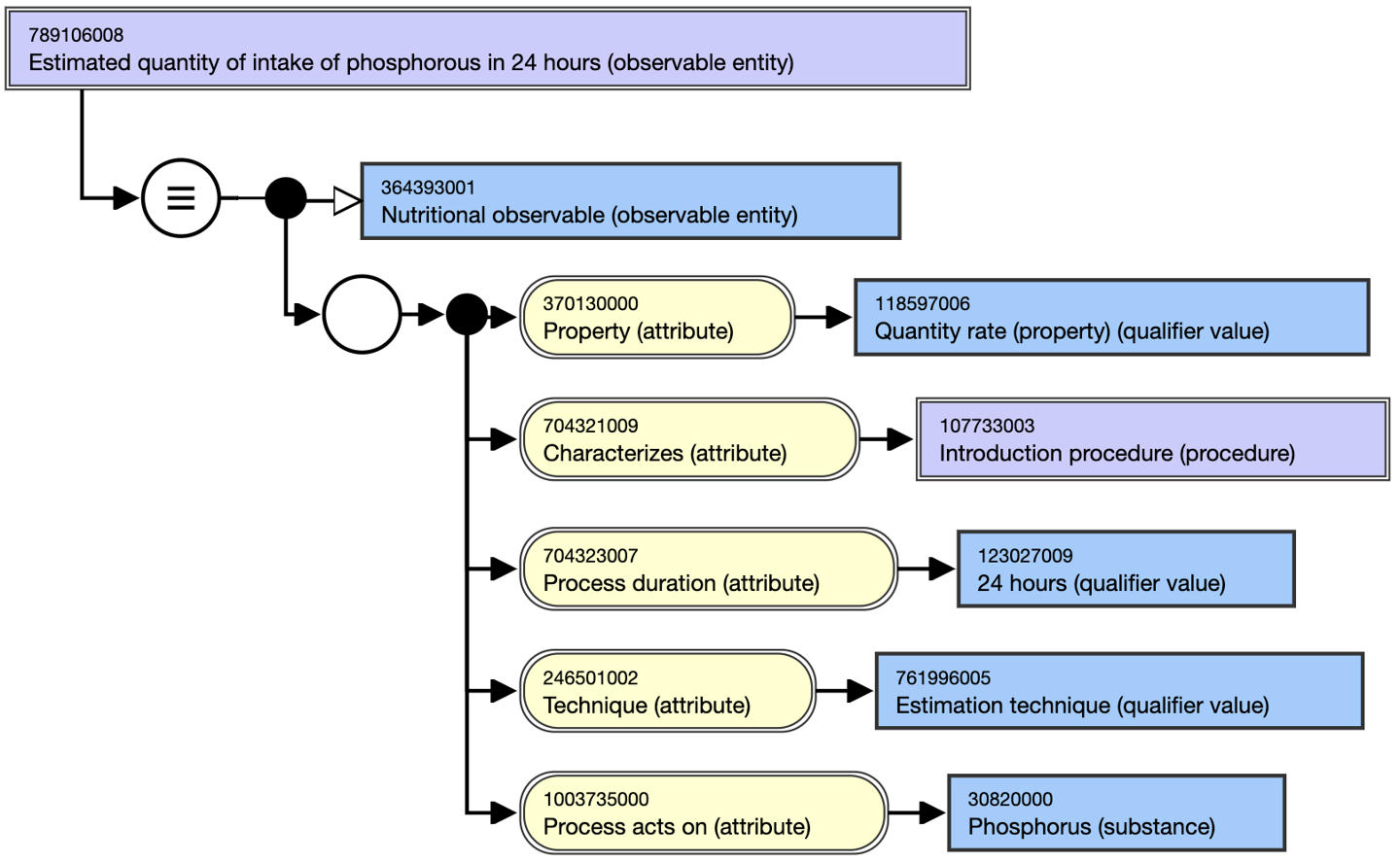
* 789106008 | Estimated quantity of intake of phosphorous in 24 hours (observable entity)|
* FSN: Estimated quantity of intake of phosphorous in 24 hours (observable entity)
* PT: Estimated quantity of intake of phosphorous in 24 hours
Figure 1. Stated view of 789106008 |Estimated quantity of intake of phosphorous in 24 hours (observable entity)|
{% hint style="warning" %}
**Dietary**
"Dietary" is considered ambiguous and should not be included in SNOMED CT. Existing content that includes "dietary" will be considered for inactivation.
{% endhint %}
Provide Feedback
---
# Agent Instructions
This documentation is published with GitBook. GitBook is the documentation platform designed so that both humans and AI agents can read, navigate, and reason over technical content effectively. Learn more at gitbook.com.
## Querying This Documentation
If you need additional information that is not directly available in this page, you can query the documentation dynamically by asking a question.
Perform an HTTP GET request on the following URL with the `ask` and `goal` query parameters:
```
GET https://docs.snomed.org/education/snomed-ct-education-editorial-guide/readme/authoring/domain-specific-modeling/observable-entity/observable-entity-modeling/nutritional-intake-observable-entities.md?ask=&goal=
```
`ask` is the immediate question: it should be specific, self-contained, and written in natural language.
`goal` is what the user is ultimately trying to achieve, the reason they need the answer. Sharing it helps GitBook give you a better, more relevant answer. A goal is most helpful when it describes the outcome the user wants rather than restating the question. For example, with `ask=how do I create an API token`, a goal like `build a script that syncs our docs to a CMS` lets GitBook tailor the answer to that use case.
The response will contain a direct answer to the question and relevant excerpts and sources from the documentation.
Use this mechanism when the answer is not explicitly present in the current page, you need clarification or additional context, or you want to retrieve related documentation sections.