> For the complete documentation index, see [llms.txt](https://docs.snomed.org/llms.txt). Markdown versions of documentation pages are available by appending `.md` to page URLs; this page is available as [Markdown](https://docs.snomed.org/education/snomed-ct-education-editorial-guide/readme/authoring/domain-specific-modeling/substance/substance-naming-and-modeling-conventions/guidelines-for-specific-substance-types/conjugate-acids-bases-and-salts.md).

# Conjugate acids, bases and salts

<mark style="color:$danger;">**This Editorial Guide is used for Education Purposes Only. It is used in the Authoring Courses and Certifications. It is based on the January 2026 Editorial Guide.**</mark>

## Overview

Acids substance concepts should be modeled with a structural parent concept.

Salts should be modeled with a conjugate base as parent (if one exists, otherwise they are modeled with a structural parent). Salts may have an Is modification of (attribute) relationship to the conjugate acid where a specific use case is identified. See examples of such use cases at [Concepts Representing a Substance or its Modifications](/education/snomed-ct-education-editorial-guide/readme/authoring/domain-specific-modeling/substance/substance-naming-and-modeling-conventions/guidelines-for-substance-hierarchy-grouper-concepts/concepts-representing-a-substance-or-its-modifications.md).

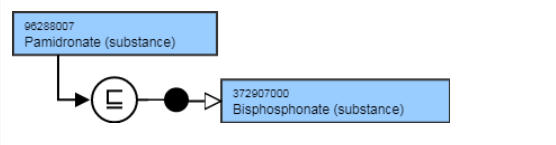
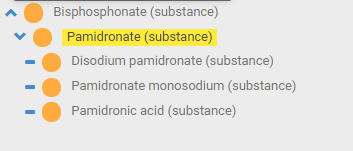
Conjugate base concepts (e.g., valproate, pamidronate, etidronate) should only be created where a specific use case is identified, for example, when required to support the definition of other concepts in the terminology.

Conjugate bases should be created as separate concepts - not added as synonyms to the corresponding acid concept.

New instances of substance concepts containing the word *salt* will not be added. The existing concepts will be reviewed, and if possible, will be replaced by equivalent compounds.

## Modeling

<table data-header-hidden><thead><tr><th width="231.39453125">Parent concept</th><th>Most distal appropriate descendant of 312413002 |Substance categorized structurally (substance)|</th></tr></thead><tbody><tr><td><strong>Parent concept</strong></td><td>Most distal appropriate descendant of 312413002 |Substance categorized structurally (substance)|</td></tr><tr><td><strong>Semantic tag</strong></td><td>(substance)</td></tr><tr><td><strong>Definition status</strong></td><td>Primitive</td></tr><tr><td><p><strong>Attribute:</strong></p><p><strong>Is Modification of</strong></p></td><td><p>Range &#x3C;105590001 |Substance (substance)|</p><p>Cardinality: 0..1</p><p>Used to identify the conjugate acid</p></td></tr><tr><td><p><strong>Attribute:</strong></p><p><strong>Has disposition</strong></p></td><td><p>Range: &#x3C;726711005 |Disposition (disposition)|</p><ul><li>While the allowed range is broader, substance concepts should only use &#x3C;726711005 |Disposition (disposition)| as the attribute value.</li></ul><p>Cardinality: 0..1</p></td></tr></tbody></table>

## Naming

Where INN names exist, these should be used for the FSN and PT.

### FSN

Pattern:

* X sulfate (substance)
* X pamidronate (substance)

For example,

* Copper sulfate (substance)
* Disodium pamidronate (substance)
* Etidronate (substance)

Exception:

* Valproate sodium (substance)

***

### Preferred Term

Pattern:

* X sulfate
* X pamidronate

For example,

* Copper sulfate
* Pamidronate monosodium
* Etidronate

Exception:

* Valproate sodium

***

### Synonyms

Pattern: Pamidronate X

For example,

* Pamidronate monosodium
* Valproate sodium

## Exemplar

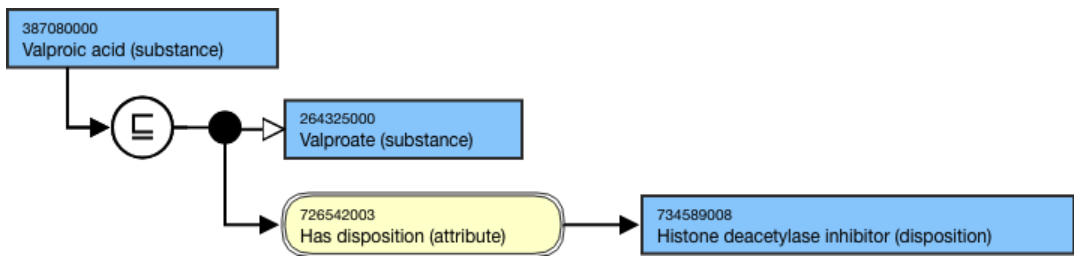
Stated view of 387080000 |Valproic acid (substance)|:

<figure><img src="https://3063935683-files.gitbook.io/~/files/v0/b/gitbook-x-prod.appspot.com/o/spaces%2FSZh4aZdgpviXMYp37bCy%2Fuploads%2Fgit-blob-3f25930922076ade84e7b471e5d73d2a12488a9a%2Fimage%20(274).png?alt=media" alt=""><figcaption></figcaption></figure>

Stated and inferred view of 387481005 |Sodium valproate (substance)|:

<figure><img src="https://3063935683-files.gitbook.io/~/files/v0/b/gitbook-x-prod.appspot.com/o/spaces%2FSZh4aZdgpviXMYp37bCy%2Fuploads%2Fgit-blob-a421c1d7ee71c9ff17374d283ba1b5e1c8bbdf47%2Fimage%20(275).png?alt=media" alt=""><figcaption></figcaption></figure>

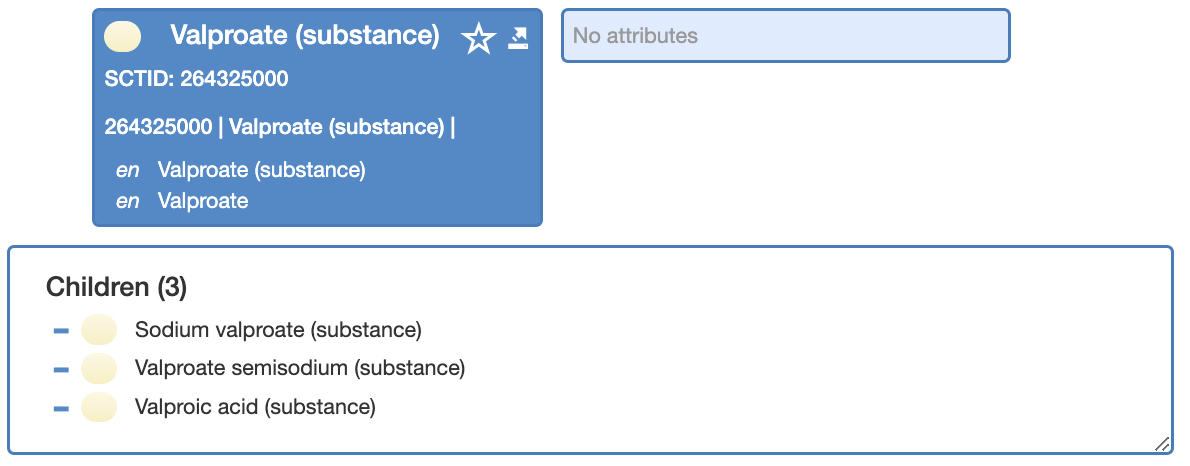
Hierarchy view of 264325000 |Valproate (substance)| subtypes:

<figure><img src="https://3063935683-files.gitbook.io/~/files/v0/b/gitbook-x-prod.appspot.com/o/spaces%2FSZh4aZdgpviXMYp37bCy%2Fuploads%2Fgit-blob-f9ea5e6ee709d9876e1ea369d8afd1da6435e412%2Fimage%20(276).png?alt=media" alt=""><figcaption></figcaption></figure>

The following illustrates the **stated** and **inferred** views.

<div align="left"><figure><img src="https://3063935683-files.gitbook.io/~/files/v0/b/gitbook-x-prod.appspot.com/o/spaces%2FSZh4aZdgpviXMYp37bCy%2Fuploads%2Fgit-blob-ff0c7a058909dae4278fa4d67dba215a79a6a018%2Fimage%20(277).png?alt=media" alt=""><figcaption></figcaption></figure></div>

<div align="left"><figure><img src="https://3063935683-files.gitbook.io/~/files/v0/b/gitbook-x-prod.appspot.com/o/spaces%2FSZh4aZdgpviXMYp37bCy%2Fuploads%2Fgit-blob-8f3604f68685a3efb545bc97c8ec137e418060a9%2Fimage%20(278).png?alt=media" alt=""><figcaption></figcaption></figure></div>

<figure><img src="https://github.com/SNOMED-Documents/snomed-editorial-guide/blob/main/authoring/substance/images/174691578.png" alt=""><figcaption></figcaption></figure>

<figure><img src="https://github.com/SNOMED-Documents/snomed-editorial-guide/blob/main/authoring/substance/images/174691579.png" alt=""><figcaption></figcaption></figure>

<a href="https://docs.google.com/forms/d/e/1FAIpQLScTmbZIf0UEQwYDkY27EEWBkaiYkHSbR0_9DmFrMLXoQLyL7Q/viewform?usp=pp_url&#x26;entry.1767247133=SCT+Editorial+Guide&#x26;entry.670899847=Conjugate%20acids%2C%20bases%20and%20salts" class="button primary">Provide Feedback</a>


---

# Agent Instructions
This documentation is published with GitBook. GitBook is the documentation platform designed so that both humans and AI agents can read, navigate, and reason over technical content effectively. Learn more at gitbook.com.

## Querying This Documentation
If you need additional information that is not directly available in this page, you can query the documentation by asking a question.

Perform an HTTP GET request on the following URL with the `ask` and `goal` query parameters:

```
GET https://docs.snomed.org/education/snomed-ct-education-editorial-guide/readme/authoring/domain-specific-modeling/substance/substance-naming-and-modeling-conventions/guidelines-for-specific-substance-types/conjugate-acids-bases-and-salts.md?ask=<question>&goal=<user_goal>
```

`ask` is the immediate question: it should be specific, self-contained, and written in natural language.
`goal` is what the user is ultimately trying to achieve, the reason they need the answer. Sharing it helps GitBook give you a better, more relevant answer. A goal is most helpful when it describes the outcome the user wants rather than restating the question. For example, with `ask=how do I create an API token`, a goal like `automate deployments from our CI pipeline` lets GitBook tailor the answer to that use case.

The response will contain a direct answer to the question and relevant excerpts and sources from the documentation.

Use this mechanism when the answer is not explicitly present in the current page, you need clarification or additional context, or you want to retrieve related documentation sections.