> For the complete documentation index, see [llms.txt](https://docs.snomed.org/llms.txt). Markdown versions of documentation pages are available by appending `.md` to page URLs; this page is available as [Markdown](https://docs.snomed.org/education/snomed-ct-education-editorial-guide/readme/authoring/domain-specific-modeling/substance/substance-naming-and-modeling-conventions/guidelines-for-specific-substance-types/metabolites.md).
# Metabolites
**This Editorial Guide is used for Education Purposes Only. It is used in the Authoring Courses and Certifications. It is based on the January 2026 Editorial Guide.**
## Overview
A metabolite is a substance created or utilized during metabolism, the process by which the body breaks down food, drugs, chemicals, or its own tissues (e.g., fat, muscle). Metabolites are differentiated from derivatives, that are compounds synthesized by modifying precursor compounds and are important in discovery of new drugs (e.g., molecules with improved efficacy, reduced toxicity, or enhanced pharmacokinetic profiles), materials science (e.g., polymers with altered properties), and agrochemicals (e.g., potent pesticide).
Concepts representing *Metabolites of X* will be considered for inclusion based upon project requirements.
## Modeling
Parent concept
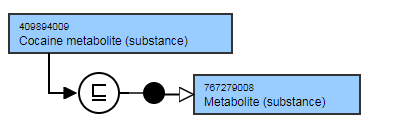
767279008 |Metabolite (substance)|
Semantic tag
(substance)
Definition status
Primitive
Attribute
None
## Naming
### FSN
Pattern: X metabolite (substance)
For example,
* Cocaine metabolite (substance)
***
### Preferred Term
Pattern: X metabolite
For example,
* Cocaine metabolite
## Exemplar
The following illustrates the **stated** and **inferred** view:
Provide Feedback
---
# Agent Instructions
This documentation is published with GitBook. GitBook is the documentation platform designed so that both humans and AI agents can read, navigate, and reason over technical content effectively. Learn more at gitbook.com.
## Querying This Documentation
If you need additional information that is not directly available in this page, you can query the documentation by asking a question.
Perform an HTTP GET request on the following URL with the `ask` and `goal` query parameters:
```
GET https://docs.snomed.org/education/snomed-ct-education-editorial-guide/readme/authoring/domain-specific-modeling/substance/substance-naming-and-modeling-conventions/guidelines-for-specific-substance-types/metabolites.md?ask=&goal=
```
`ask` is the immediate question: it should be specific, self-contained, and written in natural language.
`goal` is what the user is ultimately trying to achieve, the reason they need the answer. Sharing it helps GitBook give you a better, more relevant answer. A goal is most helpful when it describes the outcome the user wants rather than restating the question. For example, with `ask=how do I create an API token`, a goal like `automate deployments from our CI pipeline` lets GitBook tailor the answer to that use case.
The response will contain a direct answer to the question and relevant excerpts and sources from the documentation.
Use this mechanism when the answer is not explicitly present in the current page, you need clarification or additional context, or you want to retrieve related documentation sections.