> For the complete documentation index, see [llms.txt](https://docs.snomed.org/llms.txt). Markdown versions of documentation pages are available by appending `.md` to page URLs; this page is available as [Markdown](https://docs.snomed.org/education/snomed-ct-education-editorial-guide/readme/authoring/general-modeling/general-concept-inclusions-gcis.md).
# General Concept Inclusions - GCIs
**This Editorial Guide is used for Education Purposes Only. It is used in the Authoring Courses and Certifications. It is based on the January 2026 Editorial Guide.**
## Draft guidance
See the background, use cases, and examples for general concept inclusion axioms as well as explanation of the definition status at [General Concept Inclusion 0.01](https://docs.google.com/document/d/1-Tvswkw5USXydVWpBsT3iORdOFzx3qKAyownS4Enor4/edit).
## Authoring Platform User Guide for GCIs
Reference the [Authoring - Description Logic (DL) Support Features](https://docs.snomed.org/snomed-ct-user-guides/authoring-user-guide/how-to/task-edit/add-a-general-concept-inclusion-gci-to-a-concept) for technical information describing how to add an additional axiom and general concept inclusion.
## GCI display in the browser
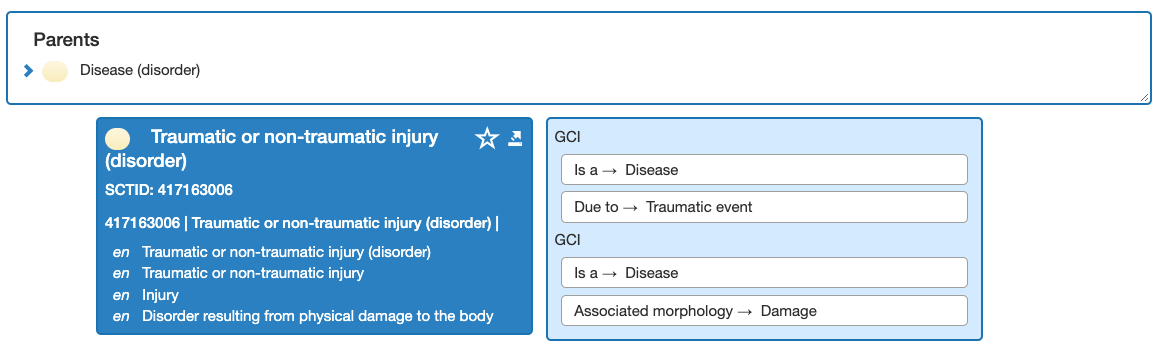
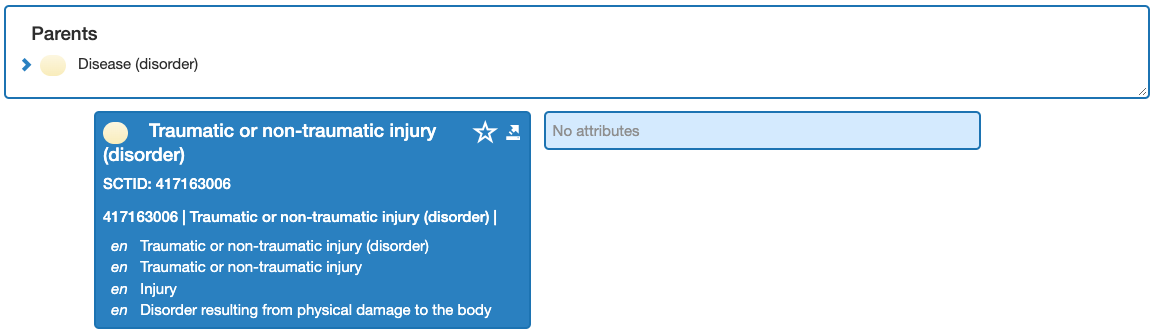
A concept with GCIs will display in the browser in the stated view only.
For example,
Below is 417163006 | Traumatic or non-traumatic injury (disorder)| in the *stated* view with the GCIs appearing to the right of the concept:
Here is the same concept in the *inferred* view without the GCIs appearing:
### Modeling concepts with a GCI-modeled supertype
General concept inclusions allow multiple definitions of a concept. A group of subtypes may be defined using GCIs and be considered subtypes of the parent concept without fully defining that parent concept. That parent concept could have multiple definitions, each of which is valid but none of which completely describes the parent concept on its own.
When modeling a concept intended to be a subconcept of a GCI concept defined by General Concept Inclusion (GCI) axioms, it is unnecessary to state the GCI concept as a parent if the logic of the concept being modeled is already covered by a GCI axiom. This holds true even if the GCI-modeled concept is primitive, as the GCI axioms ensure that the correct subsumption relationship is inferred regardless.
* For example,
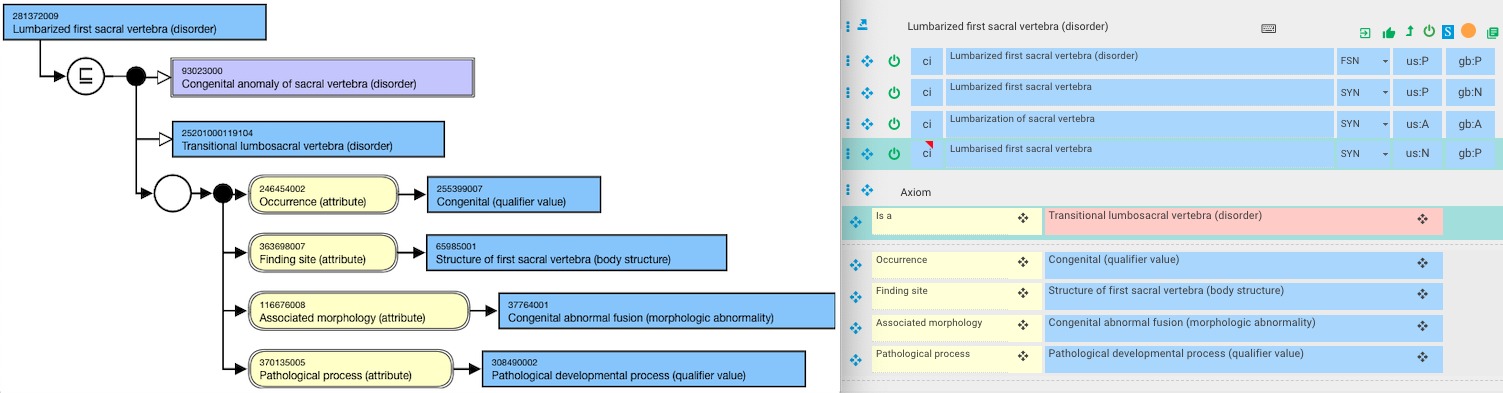
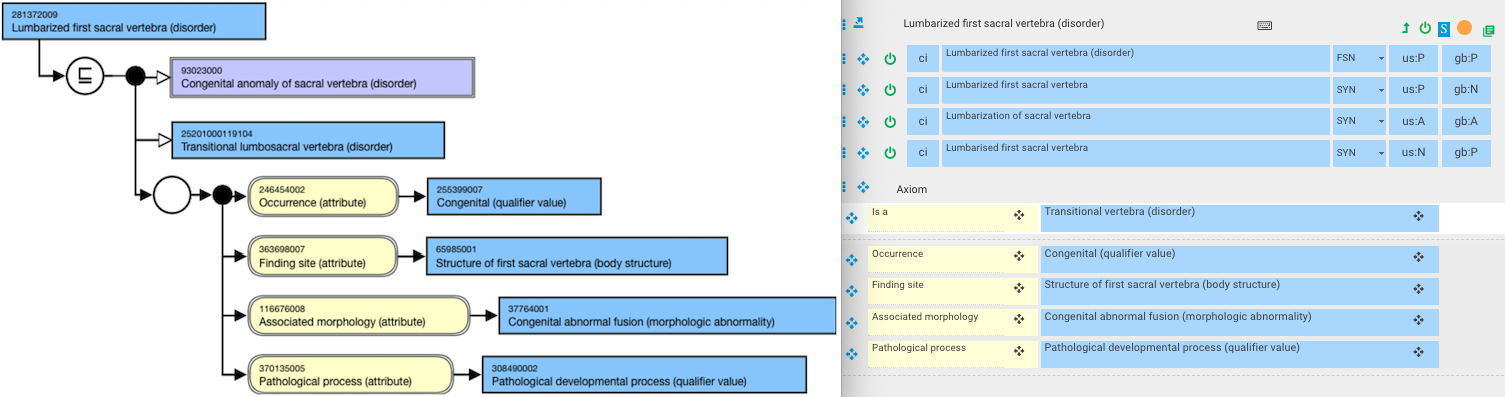
* 281372009 |Lumbarized first sacral vertebra (disorder)|
The diagram below shows Lumbarized first sacral vertebra (disorder) incorrectly modeled on the right, with a stated primitive GCI-modeled parent of Transitional lumbosacral vertebra (disorder). Transitional lumbosacral vertebra (disorder) is modeled with a GCI, as notified by the salmon pink color. The left side of the diagram shows the inferred view with two parents.
The GCI-modeled primitive concept, Transitional lumbosacral vertebra (disorder), is unnecessary to state as a parent. The diagram below shows correct modeling of Lumbarized first sacral vertebra (disorder) with the absence of Transitional lumbosacral vertebra (disorder) as a parent, and yet the inferred view diagram on the left is still the same as compared to the incorrectly modeled diagram above.
Alternatively, if a GCI-modeled parent will not subsume an appropriate child concept, then the GCI-modeled concept should be stated as a primitive supertype.
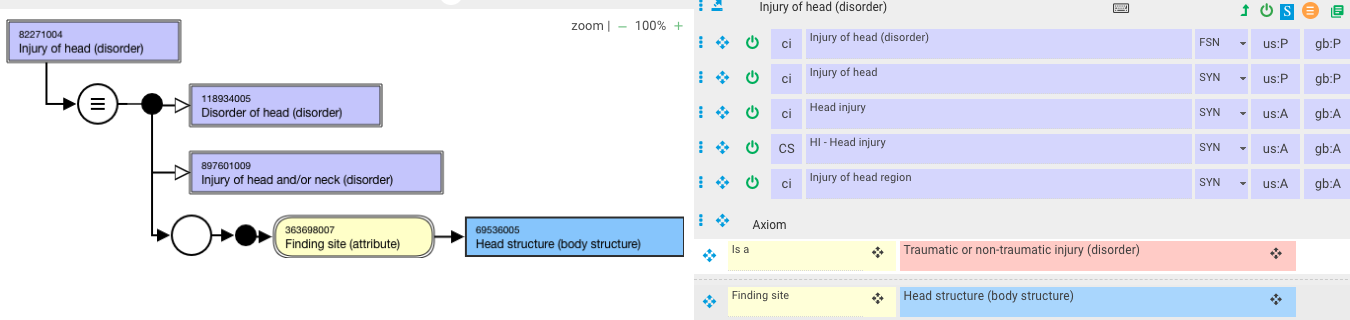
Finally, the example below of 82271004 |Injury of head (disorder)| illustrates a concept with a GCI-modeled supertype of 417163006 |Traumatic or non-traumatic injury (disorder)|. In this case, the concept Injury of head (disorder) is sufficiently defined.
## Defining GCI-modeled concepts
Though most are primitive, it is possible to define concepts modeled with GCIs. A concept must continue to meet the necessary conditions in order to be considered defined. GCIs can be added to extend the subtypes a defined concept will infer when appropriate.
## Points to Consider
* GCIs are not restricted to particular hierarchies; they can be used as applicable in any hierarchy that has a concept model.
* The Authoring Platform does not currently have the ability to create templates that include GCIs.
* A concept which has a stated "is a" relationship to a concept with GCIs will need to have GCIs added to it directly if GCIs are required to appropriately represent the concept. GCI axioms are not inherited from supertype to a subtype concept.
Provide Feedback
---
# Agent Instructions
This documentation is published with GitBook. GitBook is the documentation platform designed so that both humans and AI agents can read, navigate, and reason over technical content effectively. Learn more at gitbook.com.
## Querying This Documentation
If you need additional information that is not directly available in this page, you can query the documentation by asking a question.
Perform an HTTP GET request on the following URL with the `ask` and `goal` query parameters:
```
GET https://docs.snomed.org/education/snomed-ct-education-editorial-guide/readme/authoring/general-modeling/general-concept-inclusions-gcis.md?ask=&goal=
```
`ask` is the immediate question: it should be specific, self-contained, and written in natural language.
`goal` is what the user is ultimately trying to achieve, the reason they need the answer. Sharing it helps GitBook give you a better, more relevant answer. A goal is most helpful when it describes the outcome the user wants rather than restating the question. For example, with `ask=how do I create an API token`, a goal like `automate deployments from our CI pipeline` lets GitBook tailor the answer to that use case.
The response will contain a direct answer to the question and relevant excerpts and sources from the documentation.
Use this mechanism when the answer is not explicitly present in the current page, you need clarification or additional context, or you want to retrieve related documentation sections.