> For the complete documentation index, see [llms.txt](https://docs.snomed.org/llms.txt). Markdown versions of documentation pages are available by appending `.md` to page URLs; this page is available as [Markdown](https://docs.snomed.org/implementation-guides/cancer-synoptic-reporting-implementation-guide/4-information-models-and-terminology-binding/4.3-snomed-ct-bindings/4.3.2-terminology-binding-examples.md).
# Terminology Binding Examples
## Colorectal Cancer Resection Reporting Protocol
Below is a section of the International Collaboration on Cancer Reporting (ICCR) Colorectal Cancer Resection reporting protocol. This page exemplifies some of the bindings for this data set, namely the data elements for 'histological tumor type' and 'lymph node status'. Similar binding exists for each question/answer set within the protocol. View an excerpt from the ICCR Colorectal Cancer Histopathology Reporting Protocol:
### Binding of Histological Tumor Type
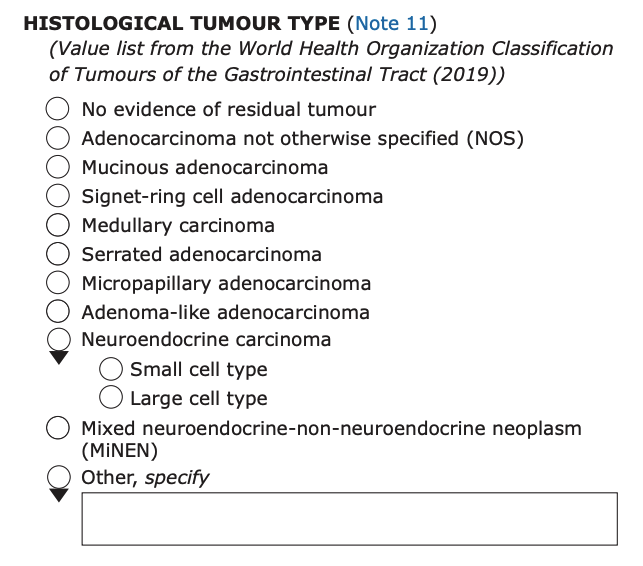
The diagram below shows the question and options for the 'histological tumor type' data element. The Observable entity to be measured/assessed is "Histological tumour type", which is represented by the SNOMED CT concept [1284862009 |Histologic type of primary malignant neoplasm of cecum and/or colon and/or rectum (observable entity)|](http://snomed.info/id/1284862009) and represents the "question" being answered. The possible "answers" or observations are listed in the table below with associated SNOMED CT concept bindings for each histology option.
Data Item| Type| Cardinality| Display| Binding
#### **Data Item: HISTOLOGICAL TUMOR TYPE**
* **Question**
* **Type:** Question
* **Cardinality:** 1..1
* **Display:** *Histological tumor type*
* **Binding:** 1284862009 |Histologic type of primary malignant neoplasm of cecum and/or colon and/or rectum (observable entity)|
* **Response options (Group)**
* **Cardinality:** 0..1
* **Options:**
* No evidence of residual tumour
* Adenocarcinoma not otherwise specified (NOS) – *1187332001 |Adenocarcinoma (morphologic abnormality)|*
* Mucinous adenocarcinoma – *72495009 |Mucinous adenocarcinoma (morphologic abnormality)|*
* Signet-ring cell adenocarcinoma – *87737001 |Signet ring cell carcinoma (morphologic abnormality)|*
* Medullary carcinoma – *32913002 |Medullary carcinoma (morphologic abnormality)|*
* Serrated adenocarcinoma – *450948005 |Serrated adenocarcinoma (morphologic abnormality)|*
* Micropapillary adenocarcinoma – *450895005 |Micropapillary carcinoma (morphologic abnormality)|*
* Adenoma-like adenocarcinoma – *28558000 |Villous adenocarcinoma (morphologic abnormality)|*
* Neuroendocrine carcinoma, small cell type – *719105002 |Small cell neuroendocrine carcinoma (morphologic abnormality)|*
* Neuroendocrine carcinoma, large cell type – *128628002 |Large cell neuroendocrine carcinoma (morphologic abnormality)|*
* Mixed neuroendocrine-non-neuroendocrine neoplasm (MiNEN) – *785766008 |Mixed neuroendocrine-non neuroendocrine neoplasm (morphologic abnormality)|*
* Other, specify
### Binding of Lymph Node Status
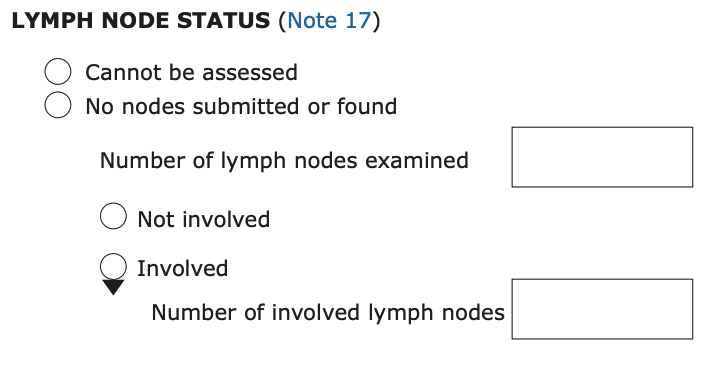
The diagram below shows the question and options for the 'lymph node status' data element. The Observable entity to be measured/assessed is "Lymph node status", which is represented by the SNOMED CT concept [1268302004 |Presence of metastatic neoplasm in lymph node in excised tissue specimen (observable entity)|](http://snomed.info/id/1268302004) and represents the "question" being answered. The possible "answers" or observations are listed in the table below with associated SNOMED CT concept bindings for each option.
**Question 1: Lymph node status**
* **Type:** Question
* **Cardinality:** 1..1
* **Display:** *Lymph node status*
* **Binding:** 1268302004 |Presence of metastatic neoplasm in lymph node in excised tissue specimen (observable entity)|
* **Response options (Group):**
* Cannot be assessed – *1156316003 |Cannot be determined (qualifier value)|*
* No nodes submitted or found – *385432009 |Not applicable (qualifier value)|*
* Not involved – *47492008 |Not seen (qualifier value)|*
* Involved – *52101004 |Present (qualifier value)|*
**Question 2: Number of lymph nodes examined**
* **Type:** Question
* **Cardinality:** 1..1
* **Display:** *Number of lymph nodes examined*
* **Binding:** 444025001 |Number of lymph nodes examined by microscopy in excised specimen (observable entity)|
* **Response value:**
* 1..1 — *Not a SNOMED Value*
**Question 3: Number of involved lymph nodes examined**
* **Type:** Question
* **Cardinality:** 1..1
* **Display:** *Number of involved lymph nodes examined*
* **Binding:** 443527007 |Number of lymph nodes containing metastatic neoplasm in excised specimen (observable entity)|
* **Response value:**
* 1..1 — *Not a SNOMED Value*
Provide Feedback
---
# Agent Instructions
This documentation is published with GitBook. GitBook is the documentation platform designed so that both humans and AI agents can read, navigate, and reason over technical content effectively. Learn more at gitbook.com.
## Querying This Documentation
If you need additional information that is not directly available in this page, you can query the documentation by asking a question.
Perform an HTTP GET request on the following URL with the `ask` and `goal` query parameters:
```
GET https://docs.snomed.org/implementation-guides/cancer-synoptic-reporting-implementation-guide/4-information-models-and-terminology-binding/4.3-snomed-ct-bindings/4.3.2-terminology-binding-examples.md?ask=&goal=
```
`ask` is the immediate question: it should be specific, self-contained, and written in natural language.
`goal` is what the user is ultimately trying to achieve, the reason they need the answer. Sharing it helps GitBook give you a better, more relevant answer. A goal is most helpful when it describes the outcome the user wants rather than restating the question. For example, with `ask=how do I create an API token`, a goal like `automate deployments from our CI pipeline` lets GitBook tailor the answer to that use case.
The response will contain a direct answer to the question and relevant excerpts and sources from the documentation.
Use this mechanism when the answer is not explicitly present in the current page, you need clarification or additional context, or you want to retrieve related documentation sections.