> For the complete documentation index, see [llms.txt](https://docs.snomed.org/llms.txt). Markdown versions of documentation pages are available by appending `.md` to page URLs; this page is available as [Markdown](https://docs.snomed.org/implementation-guides/cancer-synoptic-reporting-implementation-guide/4-information-models-and-terminology-binding/4.3-snomed-ct-bindings/4.3.3-conditional-logic-and-nested-observable-concept-binding.md).

# Conditional Logic and Nested Observable Concept Binding

A key feature often needed in Synoptic Cancer reports and other structured data entry forms is the ability to activate or deactivate certain fields based on selections made in different fields.

This condition occurs when user interface designers create data input forms to improve data entry efficiency. Specifically, entry form logic often solicits a response for a high-level observation, such as the presence of neoplasm invasion to any lymph or blood vessel. A negative observation negates the need for further elaboration. However, a positive answer may require the pathologist to indicate if the invasion is present in small lymph and/or blood vessels or larger blood vessels. Since the context of the observation, that is, "present" or "absent" is carried by the observable entity, the SNOMED CT concept for the observable entity/observation pair is different. Management of this scenario can also be managed using logical conditions. These conditions can be managed in forms logic or other rubrics.

For example:

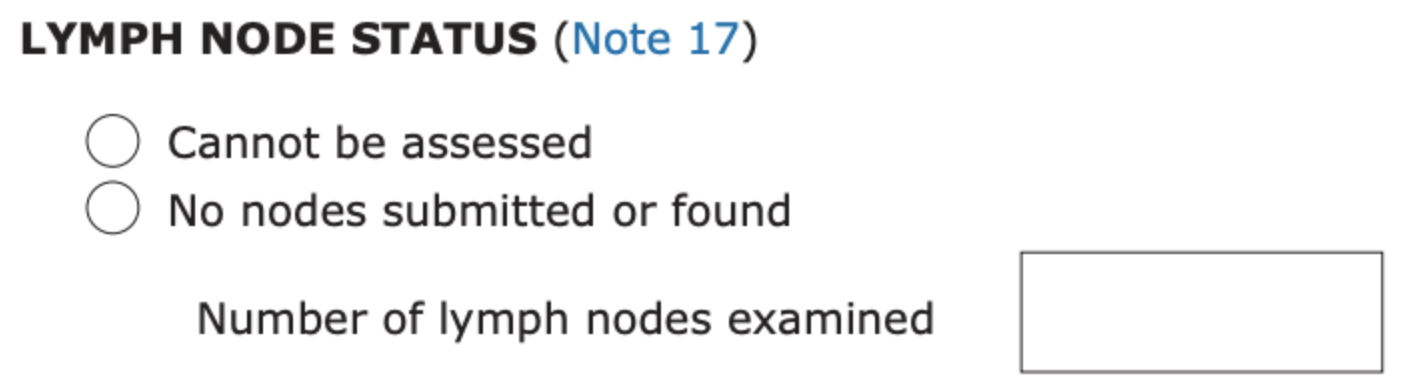
<figure><img src="/files/e6RomkjRhzJl31Kx7Eor" alt=""><figcaption><p>In this form, we can see that if the lymph node status cannot be assessed, then the entering number of nodes is not required; otherwise, it should be a required field.</p></figcaption></figure>

This type of logical connection between elements in the information model goes beyond what can be achieved with basic terminology bindings alone, necessitating an extra layer of representation. Upcoming chapters will explore how standards like HL7 FHIR offer structures specifically designed for this purpose.

<a href="https://docs.google.com/forms/d/e/1FAIpQLScTmbZIf0UEQwYDkY27EEWBkaiYkHSbR0_9DmFrMLXoQLyL7Q/viewform?usp=pp_url&#x26;entry.1767247133=Cancer+Synoptic+IG&#x26;entry.670899847=4.3.3%20Conditional%20Logic%20and%20Nested%20Observable%20Concept%20Binding" class="button primary">Provide Feedback</a>


---

# Agent Instructions
This documentation is published with GitBook. GitBook is the documentation platform designed so that both humans and AI agents can read, navigate, and reason over technical content effectively. Learn more at gitbook.com.

## Querying This Documentation
If you need additional information that is not directly available in this page, you can query the documentation dynamically by asking a question.

Perform an HTTP GET request on the current page URL with the `ask` query parameter, and the optional `goal` query parameter:

```
GET https://docs.snomed.org/implementation-guides/cancer-synoptic-reporting-implementation-guide/4-information-models-and-terminology-binding/4.3-snomed-ct-bindings/4.3.3-conditional-logic-and-nested-observable-concept-binding.md?ask=<question>&goal=<endgoal>
```

`ask` is the immediate question: it should be specific, self-contained, and written in natural language.
`goal` is optional and describes the broader end goal you are ultimately trying to accomplish on behalf of the user. GitBook uses it to tailor the answer towards what is most useful for that goal.

The response will contain a direct answer to the question and relevant excerpts and sources from the documentation.

Use this mechanism when the answer is not explicitly present in the current page, you need clarification or additional context, or you want to retrieve related documentation sections.
