> For the complete documentation index, see [llms.txt](https://docs.snomed.org/llms.txt). Markdown versions of documentation pages are available by appending `.md` to page URLs; this page is available as [Markdown](https://docs.snomed.org/implementation-guides/gps-implementation-guide/technical-application/use-of-the-global-patient-set-in-a-fhir-terminology-server.md).

# Use of the Global Patient Set in a FHIR Terminology Server

The Global Patient Set (GPS) may be used as a content source for a FHIR terminology server in environments where licensed access to the full SNOMED CT release is not available. In such configurations, the GPS supports identifier-level terminology services only and must not be treated as a substitute for a full SNOMED CT terminology server.

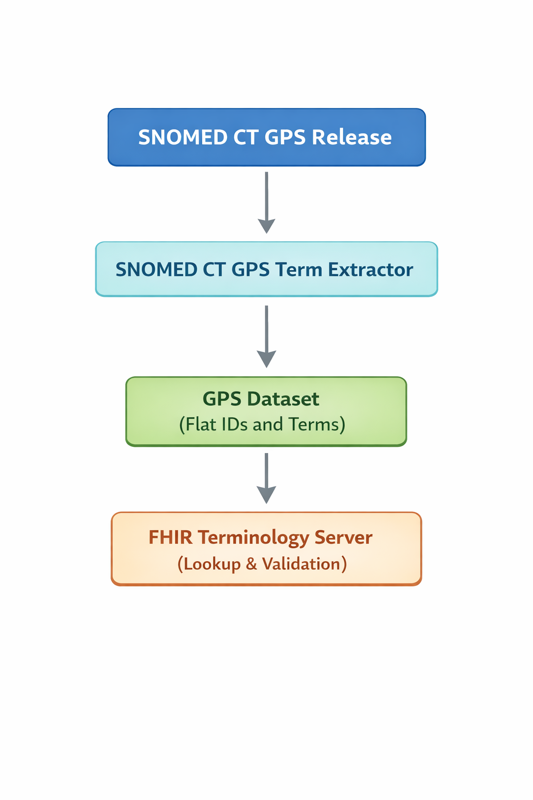
GPS content used by a terminology server is typically prepared in advance from SNOMED CT RF2 releases using tooling such as the SNOMED CT GPS Term Extractor, which derives a flat, GPS-compatible dataset suitable for loading into terminology services.

<figure><img src="/files/FBC9Ed3SQ7Gq5tlme44F" alt=""><figcaption><p>This diagram illustrates how the Global Patient Set is prepared and used within a FHIR terminology server. The SNOMED CT GPS Release provides the source content, which is processed by the SNOMED CT GPS Term Extractor to generate a simplified GPS dataset containing only concept identifiers and terms. This flat dataset is then loaded into the FHIR terminology server, where it supports identifier-level operations such as code lookup and validation, without exposing SNOMED CT semantic or hierarchical functionality.</p></figcaption></figure>

## &#x20;Supported Terminology Server Capabilities

When configured with GPS-derived content, a FHIR terminology server may support a limited set of operations that rely solely on identifiers and human-readable terms, including:

* `$lookup` for SNOMED CT concept identifiers
* `$validate-code` to confirm identifier validity and active status
* `$expand` for value sets uploaded by the user

Responses are limited to concept identifiers and associated term information and must not include semantic relationships, hierarchies, or inferred data.

## Capabilities Not Supported Using the GPS

A FHIR terminology server configured with the GPS must not support terminology services that require access to SNOMED CT semantics.

This includes, but is not limited to:

* subsumption testing
* hierarchical navigation or expansion
* $expand operations based on SNOMED CT hierarchies
* use of Expression Constraint Language (ECL)
* semantic value set expansion
* reasoning or inference

All such capabilities require licensed access to the full SNOMED CT release.


---

# Agent Instructions
This documentation is published with GitBook. GitBook is the documentation platform designed so that both humans and AI agents can read, navigate, and reason over technical content effectively. Learn more at gitbook.com.

## Querying This Documentation
If you need additional information that is not directly available in this page, you can query the documentation dynamically by asking a question.

Perform an HTTP GET request on the current page URL with the `ask` query parameter, and the optional `goal` query parameter:

```
GET https://docs.snomed.org/implementation-guides/gps-implementation-guide/technical-application/use-of-the-global-patient-set-in-a-fhir-terminology-server.md?ask=<question>&goal=<endgoal>
```

`ask` is the immediate question: it should be specific, self-contained, and written in natural language.
`goal` is optional and describes the broader end goal you are ultimately trying to accomplish on behalf of the user. GitBook uses it to tailor the answer towards what is most useful for that goal.

The response will contain a direct answer to the question and relevant excerpts and sources from the documentation.

Use this mechanism when the answer is not explicitly present in the current page, you need clarification or additional context, or you want to retrieve related documentation sections.
