> For the complete documentation index, see [llms.txt](https://docs.snomed.org/llms.txt). Markdown versions of documentation pages are available by appending `.md` to page URLs; this page is available as [Markdown](https://docs.snomed.org/implementation-guides/ncpt-implementation-guide/4-snomed-ct-content/4.2-nutrition-diagnosis.md).
# Nutrition Diagnosis
## Content and Modeling
* **Main hierarchies**
* Terminology for **nutrition diagnosis** is predominantly but not exclusively from the **Clini cal Finding** hierarchy within SNOMED CT. This hierarchy includes concepts related to nutrition-related health issues, conditions, and diagnoses, such as malnutrition, nutrient deficiencies and imbalances.
* **Key Attributes and Value Ranges**
* A range of attributes is available to represent the properties for concepts within this hierarchy ([Clinical Finding Defining Attributes](/snomed-ct-specifications/snomed-ct-editorial-guide/readme/authoring/domain-specific-modeling/clinical-finding-and-disorder/clinical-finding-attributes-summary.md)); however, the key attributes relevant for nutrition assessment and diagnosis include:
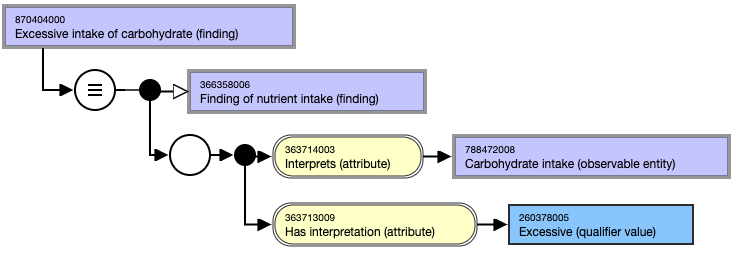
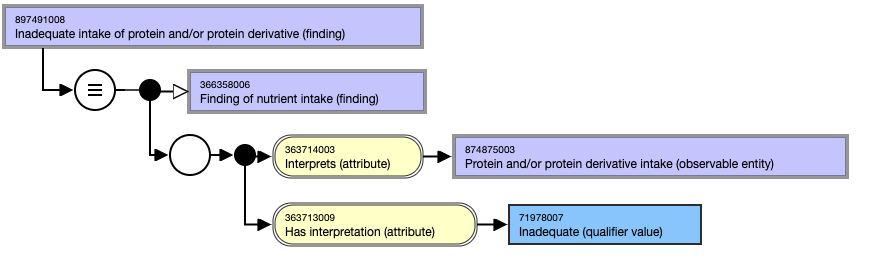
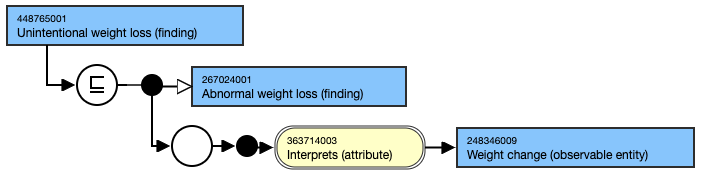
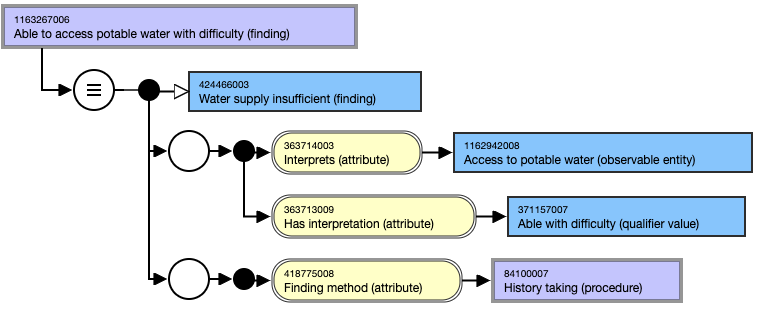
* **Interprets** : This attribute links the diagnosis to an observable entity being assessed or measured. For example, a diagnosis of '**difficulty swallowing** ' interprets the observation related to a patient's 'ability to swallow', see the example below. This attribute specifies what aspect of nutrition or health is being interpreted within the context of the diagnosis.
* **Has Interpretation** : This attribute represents the outcome or evaluation of the observation, specifying how the observation is interpreted in relation to the diagnosis. For example, it may link to a **Qualifier Value** such as **Deficient** , **Excessive** , or **Normal** intake, providing a clear description of the interpretation relevant to the nutrition diagnosis.
* These attributes, **Interprets** and **Has Interpretation** , ensure that each diagnosis is directly linked to the observed data and its interpretation, allowing for precise and standardized representation of nutrition-related diagnoses within SNOMED CT.
* **Templates**
* As part of the content development process, authoring templates were created to support future content additions and quality assurance of existing and new content in this area. [Nutrition intake (finding) - v1.0](https://conf.spaces.snomed.org/wiki/spaces/SCTEMPLATES/pages/133996630/Nutrition+intake+finding+-+v1.0)
This template ensures that nutrition diagnosis concepts are modeled in a clear, consistent, and clinically relevant manner, supporting effective documentation and interoperability in healthcare settings.
## Examples
### **Nutrition Intake findings**
Problems related to intake of energy, nutrients, fluids, bioactive constituents through oral diet or nutrition support.
**870404000 |Excessive intake of carbohydrate (finding)|**
**897491008 |Inadequate intake of protein and/or protein derivative (finding)|**
#### Clinical Nutrition Diagnoses
Nutritional findings/problems identified that relate to medical or physical conditions
**288939007 |Difficulty swallowing (finding)|**
**448765001 |Unintentional weight loss (finding)|**
#### Behavioral-Environmental Nutrition Diagnoses
Nutritional findings/problems that relate to knowledge, attitudes, beliefs, physical environment, access to food or food safety
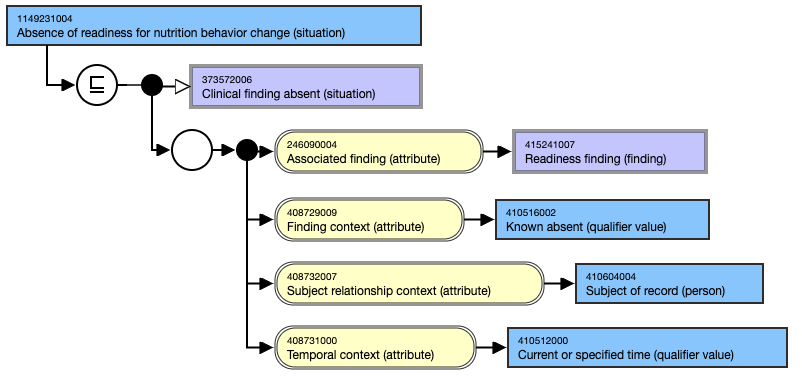
**1149231004 |Absence of readiness for nutrition behavior change (situation)|**
**1163267006 |Able to access potable water with difficulty (finding)|**
Provide Feedback
---
# Agent Instructions
This documentation is published with GitBook. GitBook is the documentation platform designed so that both humans and AI agents can read, navigate, and reason over technical content effectively. Learn more at gitbook.com.
## Querying This Documentation
If you need additional information that is not directly available in this page, you can query the documentation by asking a question.
Perform an HTTP GET request on the following URL with the `ask` and `goal` query parameters:
```
GET https://docs.snomed.org/implementation-guides/ncpt-implementation-guide/4-snomed-ct-content/4.2-nutrition-diagnosis.md?ask=&goal=
```
`ask` is the immediate question: it should be specific, self-contained, and written in natural language.
`goal` is what the user is ultimately trying to achieve, the reason they need the answer. Sharing it helps GitBook give you a better, more relevant answer. A goal is most helpful when it describes the outcome the user wants rather than restating the question. For example, with `ask=how do I create an API token`, a goal like `automate deployments from our CI pipeline` lets GitBook tailor the answer to that use case.
The response will contain a direct answer to the question and relevant excerpts and sources from the documentation.
Use this mechanism when the answer is not explicitly present in the current page, you need clarification or additional context, or you want to retrieve related documentation sections.