> For the complete documentation index, see [llms.txt](https://docs.snomed.org/llms.txt). Markdown versions of documentation pages are available by appending `.md` to page URLs; this page is available as [Markdown](https://docs.snomed.org/snomed-ct-practical-guides/snomed-ct-clinical-decision-support-guide/appendix-a-decision-support-case-studies/organizational-case-studies/university-of-utah.md).
# University of Utah
{% hint style="info" %}
The[ University of Utah School of Medicine ](#user-content-fn-1)[^1]is widely recognized for interdisciplinary research in the genetics of disease, cancer, biomedical informatics, infectious diseases, and other areas of leading-edge medicine. Innovation is a key priority of the [Biomedical Informatics Core (BMIC](#user-content-fn-2)[^2]), and information technology is critical to advancing the conduct of clinical and translational research.\\
For more information please visit .
{% endhint %}
## Overview
The [Department of Biomedical Informatics at the University of Utah](#user-content-fn-3)[^3] is an internationally recognized leader in both research and education in the field of medical informatics. The university has been a major contributor to the development of health information standards and open source initiatives, many of which have been leveraged in their own solutions, including their clinical decision support systems.
## Standards, Architectures, Techniques
As a major contributor to the development of the [OpenCDS](http://www.opencds.org/) collaborative, the University of Utah has been able use the architecture from OpenCDS to provide a service-based approach to their CDSS and clinical quality measurement efforts. As part of this effort, they have made use of HL7 International’s [Decision Support Service](http://www.hl7.org/implement/standards/product_brief.cfm?product_id=334) (DSS). The University also played a key role in the development of [OpenInfobutton](http://www.openinfobutton.org/), an opensource web service and reference implementation of HL7's infobutton standard. Infobuttons are context-sensitive links, which can be embedded in EHR systems as buttons or tabs. OpenInfobutton was funded by the US Veterans Health Administration (VHA) and developed by researchers at the VHA, Duke University, and the University of Utah.
## Using SNOMED CT
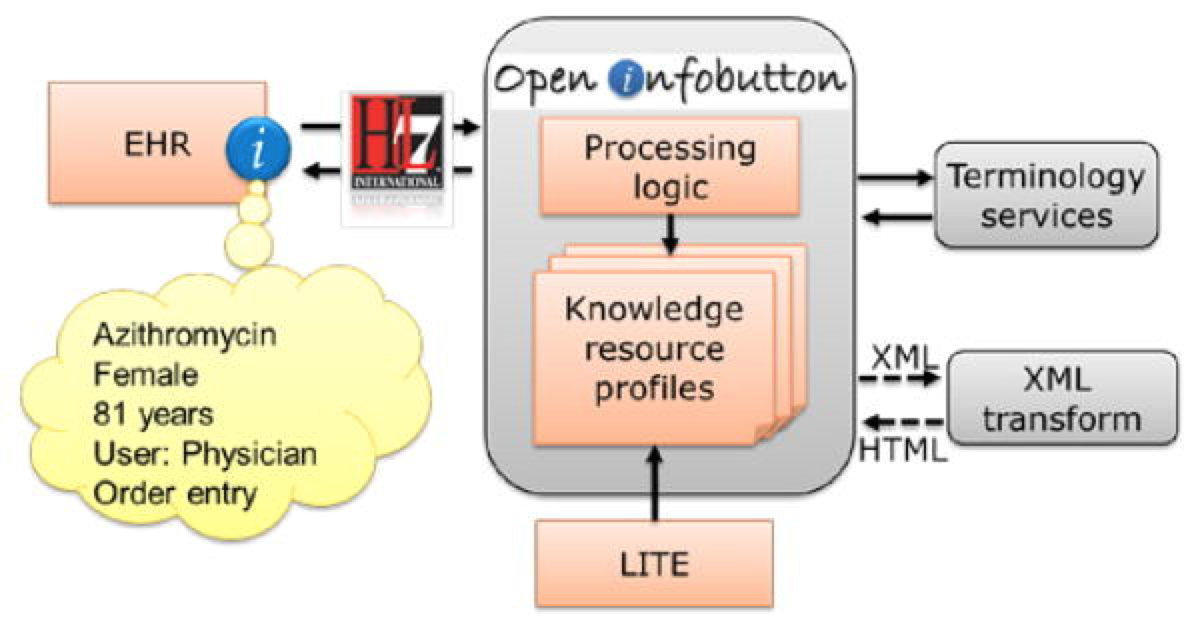
SNOMED CT value sets are used to map to clinical concepts referenced in the University's CDS rules. SNOMED CT value sets are also used to configure patient problem lists in OpenInfobutton. Since the Infobutton standard uses SNOMED CT for problem lists, SNOMED CT concept identifiers are embedded in the requests and responses between the EHR and OpenInfobutton architecture, as shown in the figure below.
Infobutton architecture which uses SNOMED CT for patient problem lists
The University has benefited from using a standardized clinical reference terminology which can be used across clinical domains. By using SNOMED CT in OpenInfobutton, the University has improved the interoperability between EHR systems and knowledge resources, by providing more efficient access to the indexed knowledge content.
Provide Feedback
[^1]:
[^2]:
[^3]:
---
# Agent Instructions
This documentation is published with GitBook. GitBook is the documentation platform designed so that both humans and AI agents can read, navigate, and reason over technical content effectively. Learn more at gitbook.com.
## Querying This Documentation
If you need additional information that is not directly available in this page, you can query the documentation by asking a question.
Perform an HTTP GET request on the following URL with the `ask` and `goal` query parameters:
```
GET https://docs.snomed.org/snomed-ct-practical-guides/snomed-ct-clinical-decision-support-guide/appendix-a-decision-support-case-studies/organizational-case-studies/university-of-utah.md?ask=&goal=
```
`ask` is the immediate question: it should be specific, self-contained, and written in natural language.
`goal` is what the user is ultimately trying to achieve, the reason they need the answer. Sharing it helps GitBook give you a better, more relevant answer. A goal is most helpful when it describes the outcome the user wants rather than restating the question. For example, with `ask=how do I create an API token`, a goal like `automate deployments from our CI pipeline` lets GitBook tailor the answer to that use case.
The response will contain a direct answer to the question and relevant excerpts and sources from the documentation.
Use this mechanism when the answer is not explicitly present in the current page, you need clarification or additional context, or you want to retrieve related documentation sections.