> For the complete documentation index, see [llms.txt](https://docs.snomed.org/llms.txt). Markdown versions of documentation pages are available by appending `.md` to page URLs; this page is available as [Markdown](https://docs.snomed.org/snomed-ct-practical-guides/snomed-ct-clinical-decision-support-guide/appendix-a-decision-support-case-studies/vendor-case-studies/simulconsult.md).
# SimulConsult
## SimulConsult
{% hint style="info" %}
Medical professionals can get a "simultaneous consult" about their patient's diagnosis using SimulConsult's diagnostic decision support software in three ways... [The database used by the software has > 6,200 diagnoses, and is most complete for genetics, neurology and increasingly pediatric rheumatology](#user-content-fn-1)[^1]. As a clinician gets advice to consider various tests, it is very helpful to get straightforward access to information about genetic testing that is available in a way that is not confusing to the clinician.[2](https://confluence.ihtsdotools.org/display/DOCCDS/SimulConsult#Footnote2)\\
For more information, please visit .
{% endhint %}
## Overview
SimulConsult is a developer of diagnostic decision support software based in the United States. They provide solutions which cover three main functionalities:
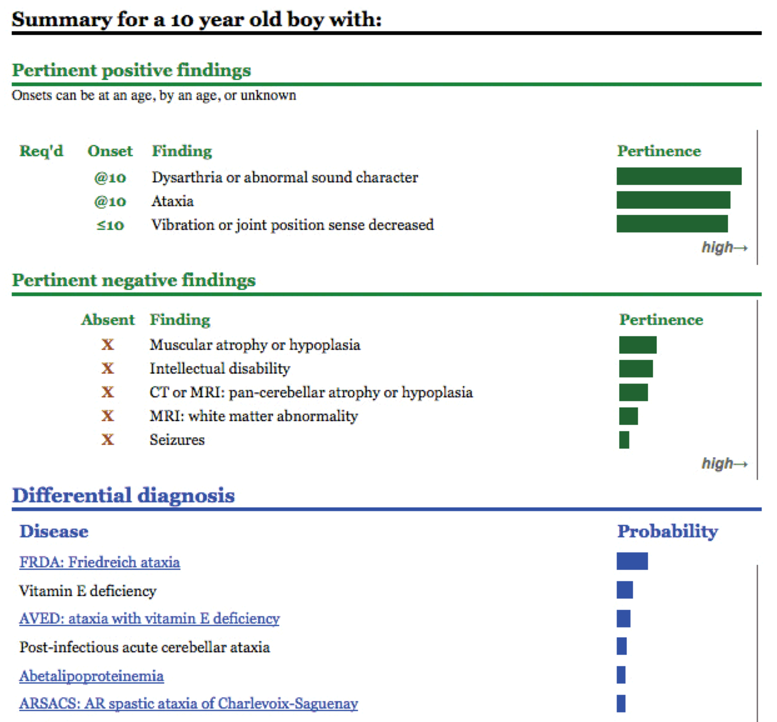
* **Clinical Diagnostic Decision** **Support:** Uses signs, symptoms, and clinical knowledge from a peer-reviewed database to suggest tests and present a differential diagnosis as shown in the image below.
* **Loss of** **Heterozygosity:** Supports the analysis of microarrays.
* **Genome-Phenome Analyzer:** Analyzes and reports on whole exome and genome testing.
Clinical findings and diseases can be represented using SNOMED CT content in SimulConsult.
By using SNOMED CT in the electronic reports generated by their software, SimulConsult has been able to achieve improved interoperability with other systems and EHRs.
## Standards and Guidelines
Diseases in SimulConsult are linked to [Online Mendelian Inheritance in Man](https://www.omim.org/) (OMIM), a catalog of Human Genes and Genetic Disorders, and additional knowledge resources from the National Library of Medicine (NLM). Tests are linked to "gene test advice" , provided by the NLM . Much of the frequency-based information is based on [GeneReviews](https://www.ncbi.nlm.nih.gov/books/NBK1116/) content.[3](https://confluence.ihtsdotools.org/display/DOCCDS/SimulConsult#Footnote3) It is also possible to assess a diagnosis based on the patient’s findings, which indicates the frequency as well as the absence or presence of findings.
## Using SNOMED CT
Although SimulConsult does not use SNOMED CT codes to drive decision support logic, their solution links to SNOMED CT through mappings provided by SimulConsult's terminology partner, [Intelligent Medical Objects](https://www.e-imo.com/) (IMO). IMO assigns proprietary codes to findings and diseases, which are then mapped to SNOMED CT. SimulConsult can be configured to use SNOMED CT terms to display [| clinical findings|](http://snomed.info/id/404684003) and [| diseases|](http://snomed.info/id/64572001) in the outputs of their software, such as patient summaries or genome analysis reports.
***
| Footnotes Ref | Notes |
| ------------------------------------------------------------------------------------- | ------------------------------------------------------------------------------------------------------------------------------------------- |
| [1](https://confluence.ihtsdotools.org/display/DOCCDS/SimulConsult#FootnoteMarker1-0) | |
| [2](https://confluence.ihtsdotools.org/display/DOCCDS/SimulConsult#FootnoteMarker2-0) | |
| [3](https://confluence.ihtsdotools.org/display/DOCCDS/SimulConsult#FootnoteMarker3-0) | [SimulConsult leverages National Library of Medicine information to improve medical diagnosis](https://www.youtube.com/watch?v=4zVquU2z53Q) |
Provide Feedback
[^1]:
---
# Agent Instructions
This documentation is published with GitBook. GitBook is the documentation platform designed so that both humans and AI agents can read, navigate, and reason over technical content effectively. Learn more at gitbook.com.
## Querying This Documentation
If you need additional information that is not directly available in this page, you can query the documentation dynamically by asking a question.
Perform an HTTP GET request on the current page URL with the `ask` query parameter, and the optional `goal` query parameter:
```
GET https://docs.snomed.org/snomed-ct-practical-guides/snomed-ct-clinical-decision-support-guide/appendix-a-decision-support-case-studies/vendor-case-studies/simulconsult.md?ask=&goal=
```
`ask` is the immediate question: it should be specific, self-contained, and written in natural language.
`goal` is optional and describes the broader end goal you are ultimately trying to accomplish on behalf of the user. GitBook uses it to tailor the answer towards what is most useful for that goal.
The response will contain a direct answer to the question and relevant excerpts and sources from the documentation.
Use this mechanism when the answer is not explicitly present in the current page, you need clarification or additional context, or you want to retrieve related documentation sections.