> For the complete documentation index, see [llms.txt](https://docs.snomed.org/llms.txt). Markdown versions of documentation pages are available by appending `.md` to page URLs; this page is available as [Markdown](https://docs.snomed.org/snomed-ct-practical-guides/snomed-ct-data-analytics-guide/7-task-oriented-analytics.md).
# Task-Oriented Analytics
The SNOMED CT analytics techniques described in the previous chapter only become useful when performing a specific analytics task intended to meet a business need. In this chapter, we consider a range of analytics tasks, which are either enabled or enhanced by using these SNOMED CT techniques.
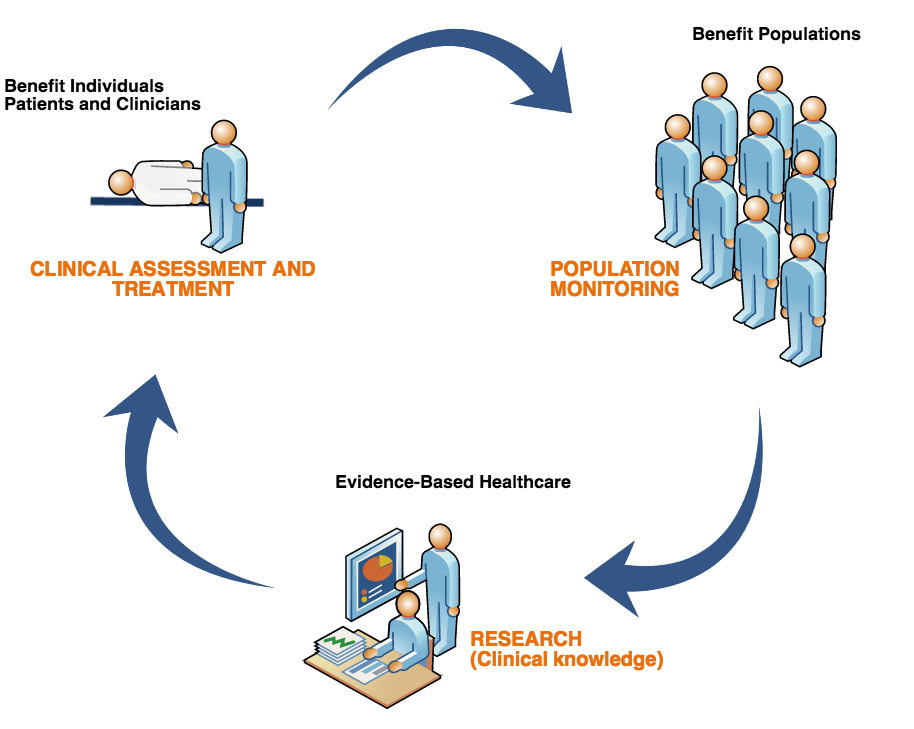
The analytics tasks which can benefit from the use of SNOMED CT techniques can be considered in three broad categories:
* Point of care analytics, which benefits individual patients and clinicians. This includes historical summaries, decision support and reporting.
* Population-based analytics, which benefits populations. This includes trend analysis, public health surveillance, pharmacovigilance, care delivery audits and healthcare service planning.
* Clinical research, which is used to improve clinical assessment and treatment guidelines. This includes identification of clinical trial candidates, predictive medicine and semantic searching of clinical knowledge.
Figure: Analytics tasks that can benefit from SNOMED CT
Many of these tasks use business intelligence capabilities, similar to those used in other sectors, such as manufacturing, retail and transportation. *Business intelligence* is the provision of historic, current and predictive views of information. Such services include reporting, online analytical processing (OLAP), data mining, process mining, complex event processing, benchmarking, text mining, predictive analysis and prescriptive analytics. In many cases, a data warehouse is used as the platform on which these services are provided.
The combination of these business intelligence techniques with the capabilities of SNOMED CT creates new opportunities to improve healthcare delivery.
Provide Feedback
---
# Agent Instructions
This documentation is published with GitBook. GitBook is the documentation platform designed so that both humans and AI agents can read, navigate, and reason over technical content effectively. Learn more at gitbook.com.
## Querying This Documentation
If you need additional information that is not directly available in this page, you can query the documentation dynamically by asking a question.
Perform an HTTP GET request on the current page URL with the `ask` query parameter, and the optional `goal` query parameter:
```
GET https://docs.snomed.org/snomed-ct-practical-guides/snomed-ct-data-analytics-guide/7-task-oriented-analytics.md?ask=&goal=
```
`ask` is the immediate question: it should be specific, self-contained, and written in natural language.
`goal` is optional and describes the broader end goal you are ultimately trying to accomplish on behalf of the user. GitBook uses it to tailor the answer towards what is most useful for that goal.
The response will contain a direct answer to the question and relevant excerpts and sources from the documentation.
Use this mechanism when the answer is not explicitly present in the current page, you need clarification or additional context, or you want to retrieve related documentation sections.