> For the complete documentation index, see [llms.txt](https://docs.snomed.org/llms.txt). Markdown versions of documentation pages are available by appending `.md` to page URLs; this page is available as [Markdown](https://docs.snomed.org/snomed-ct-practical-guides/snomed-ct-data-analytics-guide/8-data-architectures/8.2-data-warehouse.md).
# Data Warehouse
A data warehouse is a central data store of integrated data from one or more disparate sources, used for reporting and data analysis. While operational systems are optimized for the preservation of data integrity and the speed of recording transactions, data warehouses are optimized for the high performance execution of queries.
The typical Extract-Transfer-Load (ETL) based data warehouse uses a staging layer to clean the extracted data and transform it into a homogeneous structure and standardized terminology. During this process, the techniques from Preparing Data for Analytics, such as mapping codes to SNOMED CT, can be used to prepare the data for analytics. The transformed data is then loaded into the data warehouse, and indexed, so that optimized analysis of the data can begin.
The benefits of using a data warehouse include:
* Data from multiple heterogeneous sources can be integrated to enable consistent querying over data from all sources
* The operational clinical system does not suffer performance degradation when running large analytics queries over historical data
* The data quality can be improved by cleaning the data, and mapping non-SNOMED CT codes to SNOMED CT
* The data can be restructured to optimize query performance
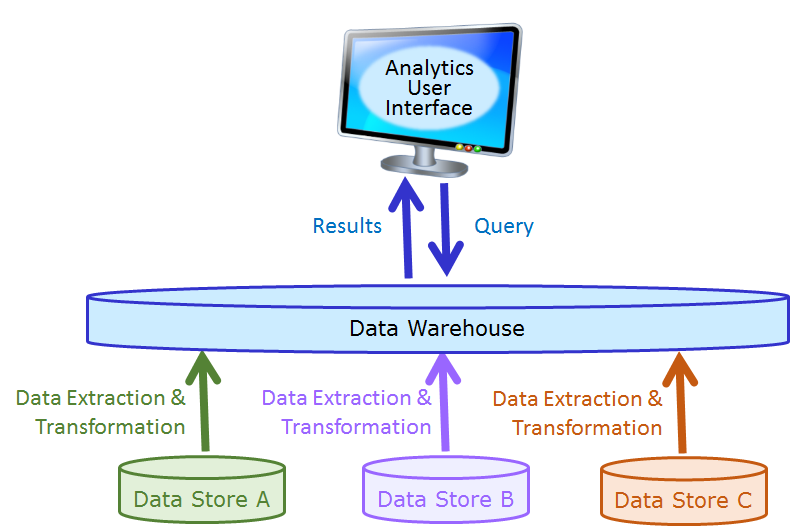
The following figure illustrates an architecture in which the patient record data is extracted from its operational data store and loaded into a data warehouse for reporting and other analytics purposes.
Figure 8.2-1: Querying using a data warehouse
Commercial data warehousing solutions that support SNOMED CT include Cambio's COSMIC Intelligence, Cerner's PowerInsight Data Warehouse (PIDW) and Cerner's Health Facts Data Warehouse.
***
Provide Feedback
---
# Agent Instructions
This documentation is published with GitBook. GitBook is the documentation platform designed so that both humans and AI agents can read, navigate, and reason over technical content effectively. Learn more at gitbook.com.
## Querying This Documentation
If you need additional information that is not directly available in this page, you can query the documentation by asking a question.
Perform an HTTP GET request on the following URL with the `ask` and `goal` query parameters:
```
GET https://docs.snomed.org/snomed-ct-practical-guides/snomed-ct-data-analytics-guide/8-data-architectures/8.2-data-warehouse.md?ask=&goal=
```
`ask` is the immediate question: it should be specific, self-contained, and written in natural language.
`goal` is what the user is ultimately trying to achieve, the reason they need the answer. Sharing it helps GitBook give you a better, more relevant answer. A goal is most helpful when it describes the outcome the user wants rather than restating the question. For example, with `ask=how do I create an API token`, a goal like `automate deployments from our CI pipeline` lets GitBook tailor the answer to that use case.
The response will contain a direct answer to the question and relevant excerpts and sources from the documentation.
Use this mechanism when the answer is not explicitly present in the current page, you need clarification or additional context, or you want to retrieve related documentation sections.