> For the complete documentation index, see [llms.txt](https://docs.snomed.org/llms.txt). Markdown versions of documentation pages are available by appending `.md` to page URLs; this page is available as [Markdown](https://docs.snomed.org/snomed-ct-practical-guides/snomed-ct-extension-guide/4-logical-design/4.3-extensions/4.3.1-components/4.3.1.2-concepts.md).
# Concepts
## Overview
Concepts can be added to an extension, either to address content gaps or to expand the scope of SNOMED CT to include concepts that are used locally. Extension concepts are distributed in a [concept file](/snomed-ct-specifications/snomed-ct-release-file-specification/component-release-file-specification/4.2-file-format-specifications/4.2.1-concept-file-specification.md), which follows the standard [RF2 release file format](https://docs.snomed.org/snomed-ct-specifications/snomed-ct-release-file-specification/). For more details on the principles and processes for authoring concepts in an extension, please refer to [Authoring Concepts](/snomed-ct-practical-guides/snomed-ct-extension-guide/5-key-steps/5.4-authoring/5.4.2-authoring-concepts.md).
## Attributes
In addition to the four [common attributes](/snomed-ct-practical-guides/snomed-ct-extension-guide/4-logical-design/4.3-extensions/4.3.1-components/4.3.1.1-common-attributes.md), extension concepts also have a definitionStatusId.
### definitionStatusId
The definitionStatusId attribute specifies whether the concept is [primitive](https://confluence.ihtsdotools.org/display/DOCGLOSS/primitive+concept) or fully defined. If defining relationships are added, which sufficiently define the concept, then the definitionStatusId should be set to [| Defined|](http://snomed.info/id/900000000000073002) . Otherwise, the extension concept is [| Primative|](http://snomed.info/id/900000000000074008) .
## Example
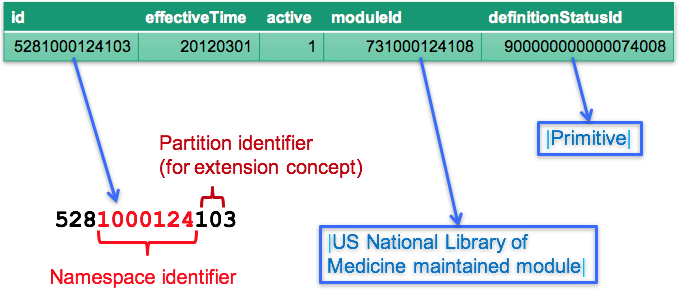
In the image below, a row from the concept table of the 20170901 US edition is shown, which represents the concept [5281000124103 | Persistent asthma|](http://snomed.info/id/5281000124103) .
Note that the attribute values in this row have been set according to the rules previously described.
A row from the concept table in the 20170901 US Edition
Please note the following:
* The concept id uses a namespace identifier allocated to the National Library of Medicine (NLM). This indicates that this concept was originally created by the NLM.
* The concept id uses a partition identifier of “10”. This indicates that the concept was created in an extension.
* The moduleId indicates that this concept is included in the [| US National Library of Medicine maintained module|](http://snomed.info/id/731000124108) , which is a module in the US Edition.
* The definitionStatusId states that this concept is [| Primitive|](http://snomed.info/id/900000000000074008) .
Provide Feedback
---
# Agent Instructions
This documentation is published with GitBook. GitBook is the documentation platform designed so that both humans and AI agents can read, navigate, and reason over technical content effectively. Learn more at gitbook.com.
## Querying This Documentation
If you need additional information that is not directly available in this page, you can query the documentation dynamically by asking a question.
Perform an HTTP GET request on the current page URL with the `ask` query parameter, and the optional `goal` query parameter:
```
GET https://docs.snomed.org/snomed-ct-practical-guides/snomed-ct-extension-guide/4-logical-design/4.3-extensions/4.3.1-components/4.3.1.2-concepts.md?ask=&goal=
```
`ask` is the immediate question: it should be specific, self-contained, and written in natural language.
`goal` is optional and describes the broader end goal you are ultimately trying to accomplish on behalf of the user. GitBook uses it to tailor the answer towards what is most useful for that goal.
The response will contain a direct answer to the question and relevant excerpts and sources from the documentation.
Use this mechanism when the answer is not explicitly present in the current page, you need clarification or additional context, or you want to retrieve related documentation sections.