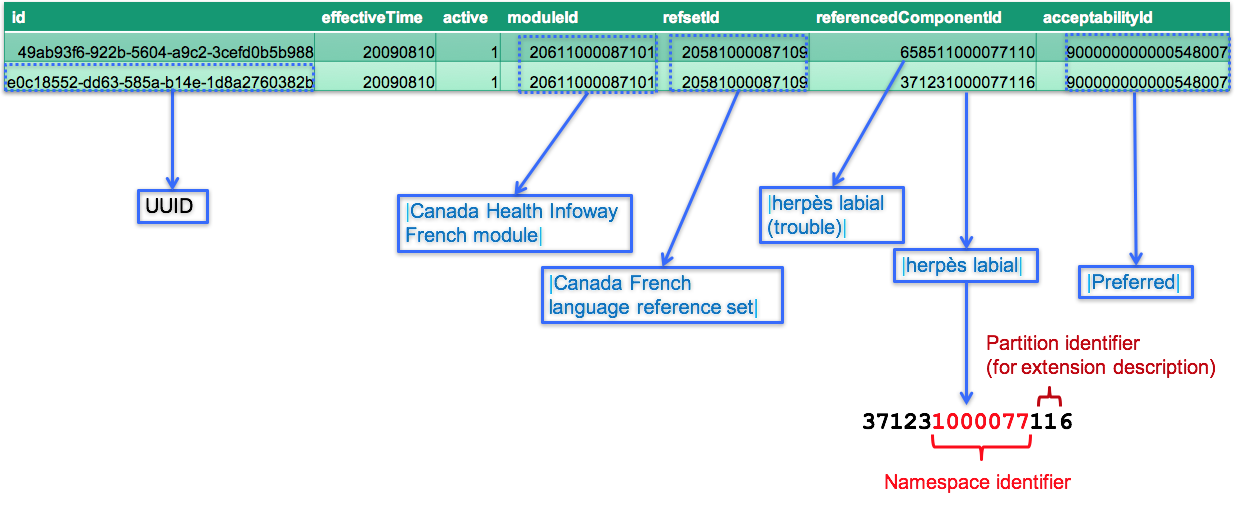
Rows from the |Canada French language reference set
| Attribute | Data Type | Use in a Language Reference Set |
|---|---|---|
| id | UUID | Can be generated using a standard UUID generator. |
| effectiveTime | Time | Specifies the date on which this version of the reference set member was released. |
| active | Boolean | Indicates whether or not the reference set member is active at the given effectiveTime. This value is set to "1" for new reference set members. |
| moduleId | SCTID | Identifies the module to which this reference set member belongs. For members in an extension, this will always be a module created by the extension producer. |
| refsetId | SCTID | This refers to the concept id of a descendant of [ |
| referencedComponentId | SCTID | The referencedComponentId refers to the id of the description whose acceptability is being defined. |
| acceptabilityId | SCTID | The acceptabilityId indicates whether the description referenced by the referencedComponentId is [ |
Rows from the |Canada French language reference set