> For the complete documentation index, see [llms.txt](https://docs.snomed.org/llms.txt). Markdown versions of documentation pages are available by appending `.md` to page URLs; this page is available as [Markdown](https://docs.snomed.org/snomed-ct-practical-guides/snomed-ct-extension-guide/5-key-steps.md).
# Key Steps
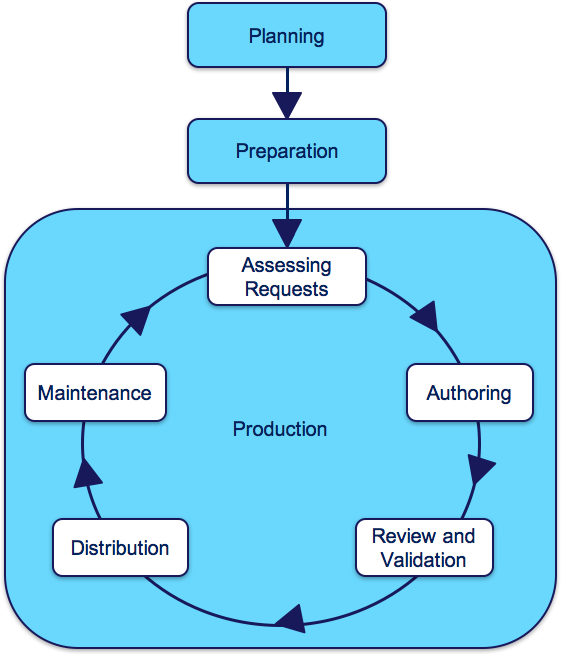
While the lifecycle of each extension will vary due to differences in requirements and scope, three main phases can typically be identified - *Planning* , *Preparation* and *Production*.
1. The *planning phase* ensures that the requirements can be met by the extension design, resources and processes used.
2. The *preparation* phase ensures that the technical prerequisites are in place, including the namespace, module(s), module dependencies and appropriate tooling.
3. The *production phase* involves the development, distribution and maintenance of the extension.
The production phase can be further divided into several key steps, including Assessing *Requests,* *Authoring* , *Review* , *Distribution* , and *Maintenance*.
1. *Assessing Requests* - Requests for new terminology products or content changes are submitted and processed to determine whether or not they will be accepted into the extension, submitted to a National Edition, submitted to the International Edition, or rejected.
2. *Authoring* - SNOMED CT components and reference set members are added, modified or inactivated according to the SNOMED CT editorial principles and policies. It should be noted that:
* It is the responsibility of the extension producer to ensure that the quality and integrity of the extension is maintained, and that all content changes are made in a module that is owned by the *terminology producer* themselves.
* All changes made to SNOMED CT components or reference set members should be represented as new versions and assigned to a module owned by the *terminology producer*. No changes are permitted to content of the International Release. Any modifications resulting in changes to the classification of international content must be accompanied by a disclaimer notifying users of the differences between the extension edition and the International Edition.
* Any substantive improvements or corrections to the content in the International Edition that is made in an extension should be submitted to SNOMED International in a timely fashion to improve the quality of the International Edition for all users.
3. *Review* *and Validation* - SNOMED CT extension content should be validated using automated tests both at the time of authoring and before a release is packaged for distribution. In addition, manual review of the terminology content is also vital to ensure that it meets the quality standards for usability and clinical safety which cannot be tested automatically.
4. *Distribution* - This involves classifying the extension content [\*1](#user-content-fn-1)[^1] , packaging the release files, validating the distribution package, and making the release package available to *terminology consumers*.
5. *Maintenance* - A SNOMED CT extension must be maintained to respond to new change requests, and to ensure that the consistency and integrity with the International Edition (and other modules on which it depends) is maintained appropriately.
These key phases and steps in the lifecycle of an extension are illustrated below in the diagram below. Further details about each of these key phases and steps are provided in the subsequent sections, together with the principles that should be followed to ensure the quality and integrity of a SNOMED CT extension.
Extension Lifecycle Overview
Provide Feedback
[^1]: In practice, classification of an extension module requires it to be combined with the all the modules on which it depends, including the International Edition modules.
---
# Agent Instructions
This documentation is published with GitBook. GitBook is the documentation platform designed so that both humans and AI agents can read, navigate, and reason over technical content effectively. Learn more at gitbook.com.
## Querying This Documentation
If you need additional information that is not directly available in this page, you can query the documentation dynamically by asking a question.
Perform an HTTP GET request on the current page URL with the `ask` query parameter, and the optional `goal` query parameter:
```
GET https://docs.snomed.org/snomed-ct-practical-guides/snomed-ct-extension-guide/5-key-steps.md?ask=&goal=
```
`ask` is the immediate question: it should be specific, self-contained, and written in natural language.
`goal` is optional and describes the broader end goal you are ultimately trying to accomplish on behalf of the user. GitBook uses it to tailor the answer towards what is most useful for that goal.
The response will contain a direct answer to the question and relevant excerpts and sources from the documentation.
Use this mechanism when the answer is not explicitly present in the current page, you need clarification or additional context, or you want to retrieve related documentation sections.