> For the complete documentation index, see [llms.txt](https://docs.snomed.org/llms.txt). Markdown versions of documentation pages are available by appending `.md` to page URLs; this page is available as [Markdown](https://docs.snomed.org/snomed-ct-practical-guides/snomed-ct-extension-guide/5-key-steps/5.6-distribution/5.6.2-distribution-approaches.md).
# Distribution Approaches
There are two main approaches to distributing SNOMED CT extensions and editions.
* File-based distribution
* Service-based distribution
Either or both of these approaches may be applied by extension producers to make their content available to consumers.
## File-Based Distribution
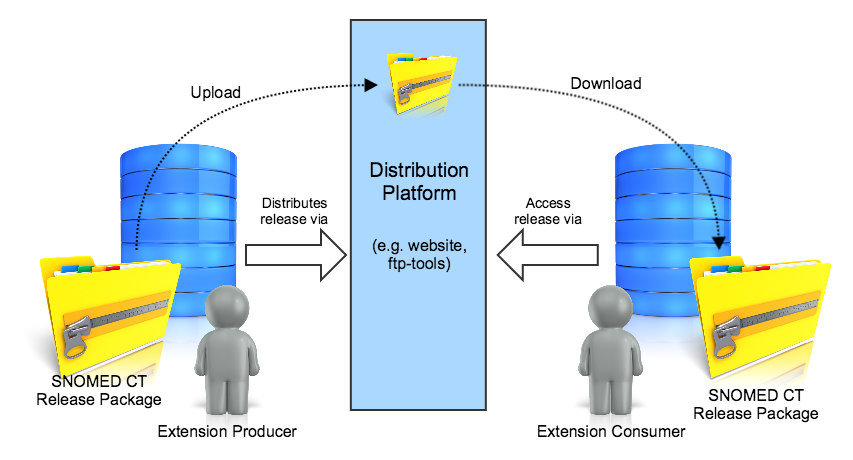
The most common approach to distribution is using a file-based distribution approach, in which the SNOMED CT content is accessed via a distribution platform that allows a complete release package to be downloaded, as illustrated in the diagram below.
Figure 5.6.2-1: File-based distribution
### Examples
#### Member Licensing and Distribution Service
SNOMED International makes the International release available as downloadable packages, using a file-based distribution approach. The Member Licensing and Distribution Service (MLDS) is an online service for managing affiliate licenses for SNOMED International and participating Members, and for distributing SNOMED International products to affiliate licensees. An increasing number of SNOMED International Members use the MLDS to distribute their National Edition, including Denmark, Sweden, Norway, Belgium and the Netherlands. The MLDS serves two types of users:
* **SNOMED International and NRC staff** – Staff of organizations, including SNOMED International, who are using the MLDS to distribute SNOMED CT editions and extensions.
* **Affiliates and interested parties** – Individuals and organizations who agree to a license to download and use SNOMED CT in non-Member countries, and in Member countries who are using the MLDS to distribute their national extension. Please note, that when using SNOMED CT in non-Member countries, an Affiliate license is required, and use is subject to fees. For more information, please refer to SNOMED CT [Licensing](https://docs.snomed.org/snomed-ct-practical-guides/vendor-introduction-to-snomed-ct/).
The MLDS service can be accessed at [MLDS](http://snomed.org/mlds).
#### Platforms Provided by a National Release Centre
In some Member countries, SNOMED CT is downloaded from a local platform provided by the National Release Center (NRC) of that country. For example:
* In the US - [National Library of Medicine / National Institutes of Health](https://www.nlm.nih.gov/healthit/snomedct/)
* In Canada - [Canada Health Infoway](https://infocentral.infoway-inforoute.ca/en/standards/international/snomed-ct)
* And in the UK - [NHS Digital’s UK Terminology Centre](https://digital.nhs.uk/snomed-ct)
To download SNOMED CT in a Member country:
* Visit to the SNOMED International Members page at and find your member organization
* Visit your NRC’s website or contact them by email
* Download the relevant release files from your NRC
* Note that most NRCs will require you to register for an account before SNOMED CT can be downloaded
* In some countries SNOMED CT is alternatively provided via terminology services
## Service-Based Distribution
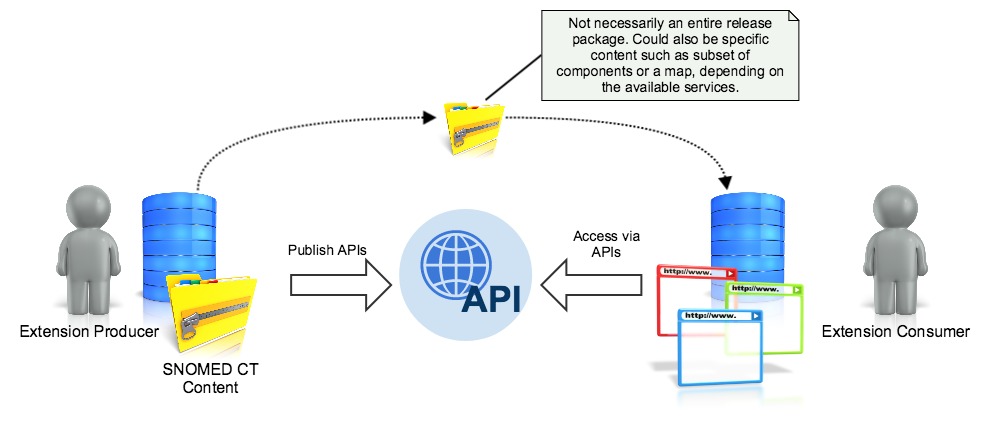
Another option for distributing SNOMED CT is using a service-based approach. This approach allows users to access the entire release, or specific parts of the release via query services using a set of predefined Application Programming Interfaces (APIs).[\*1 ](#user-content-fn-1)[^1]Service-based distribution is illustrated in the diagram below.
Service-based distribution
The extension producer may choose to provide different types of service-based distribution services, such as:
* A service that provides access to specific SNOMED CT subsets
* A service that provides access to the content within a specific set of modules (e.g. the extension modules)
* A service that provides access to the content in an entire edition, including both the extension content and the modules on which the extension depends
Using a terminology server API, extension producers can support the needs of extension consumers, without the consumer needing to download the full release files themselves. For example, the service could allow access to specific reference sets, support querying for the descendants of a particular concept, or determine the permitted range for a given attribute. Distribution services may also provide options for accessing different editions, and different versions of those editions.
As the range of possible terminology services is extensive, extension producers need to decide on an appropriate API to meet the needs of their consumers. Options include both standardized and commercial APIs, such as:
* SNOMED International's [terminology server](https://www.implementation.snomed.org/terminology-services) Snowstorm
* [HL7 FHIR terminology services](https://www.hl7.org/fhir/terminology-service.html) API
* HL7 Common Terminology Services 2 (CTS 2)
* Commercial terminology server APIs that offer SNOMED CT search and query
***
Provide Feedback
[^1]: An Application Programming Interface is a set of rules and specifications that enable communication between software programs.
The way an *application programming interface* operates is similar to a user interface, which facilitates interaction between humans and computers.
---
# Agent Instructions
This documentation is published with GitBook. GitBook is the documentation platform designed so that both humans and AI agents can read, navigate, and reason over technical content effectively. Learn more at gitbook.com.
## Querying This Documentation
If you need additional information that is not directly available in this page, you can query the documentation by asking a question.
Perform an HTTP GET request on the following URL with the `ask` and `goal` query parameters:
```
GET https://docs.snomed.org/snomed-ct-practical-guides/snomed-ct-extension-guide/5-key-steps/5.6-distribution/5.6.2-distribution-approaches.md?ask=&goal=
```
`ask` is the immediate question: it should be specific, self-contained, and written in natural language.
`goal` is what the user is ultimately trying to achieve, the reason they need the answer. Sharing it helps GitBook give you a better, more relevant answer. A goal is most helpful when it describes the outcome the user wants rather than restating the question. For example, with `ask=how do I create an API token`, a goal like `automate deployments from our CI pipeline` lets GitBook tailor the answer to that use case.
The response will contain a direct answer to the question and relevant excerpts and sources from the documentation.
Use this mechanism when the answer is not explicitly present in the current page, you need clarification or additional context, or you want to retrieve related documentation sections.