> For the complete documentation index, see [llms.txt](https://docs.snomed.org/llms.txt). Markdown versions of documentation pages are available by appending `.md` to page URLs; this page is available as [Markdown](https://docs.snomed.org/snomed-ct-practical-guides/snomed-ct-mapping-guide/map-development/7-evaluate-and-test.md).
# Evaluate and test
Ensuring map quality is important for the successful use of SNOMED CT. It is crucial that the map's content references the concepts that represent the meaning of the source data it is to be linked to. In addition, it is important that the human interpretation of the concepts referred to aligns with the logical definition provided by SNOMED CT. Even when using maps for less patient safety-critical purposes, the quality of the map needs to be sufficient to be trusted to serve its purpose.
## Stages of Quality Assurance
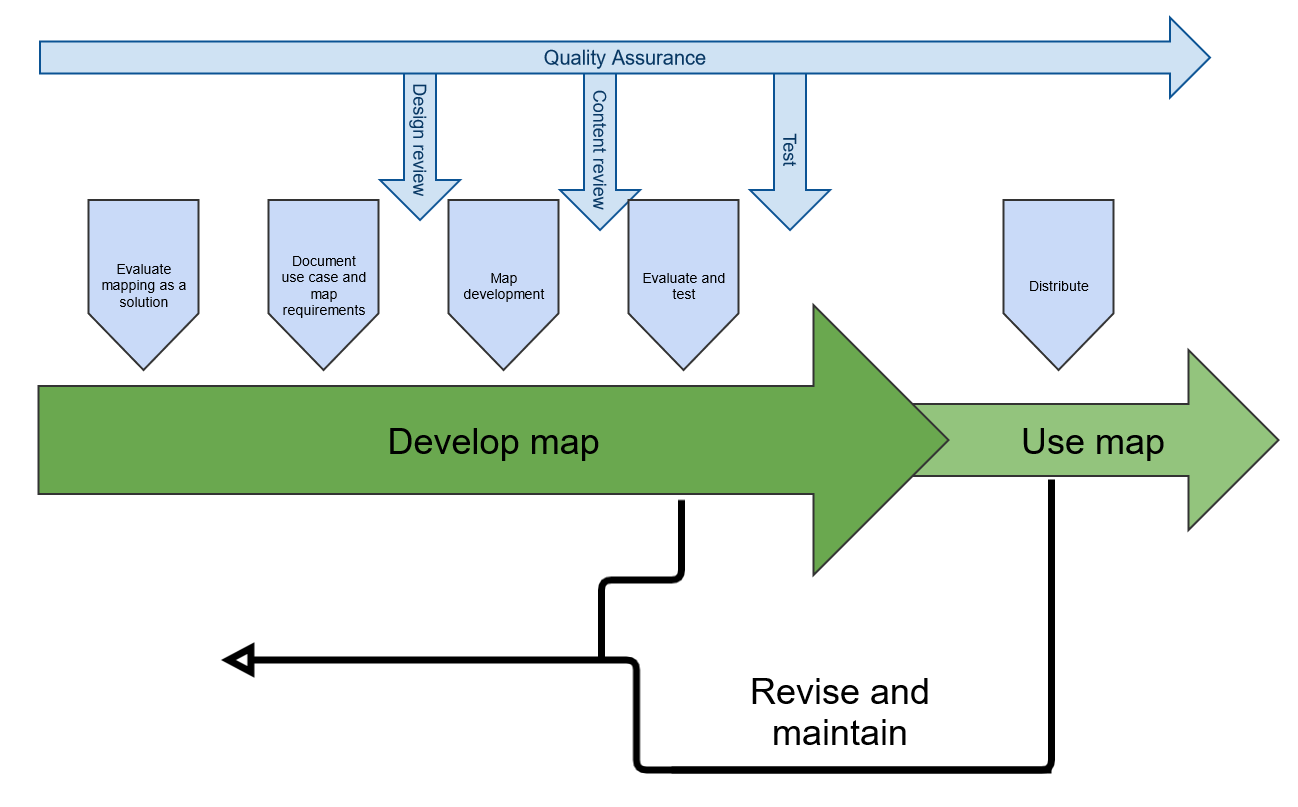
Reviewing a map set is important throughout the map development process; at least three types of validation should be emphasized, see illustration below.
* **Design review:** The overall objective of this review is to verify whether the map design meets the requirements.
* **Content review:** The overall objective of this review is to verify whether the selected targets are appropriately mapped to the source codes.
* **Test:** The overall objective of testing the map is to validate it in the context in which it will be used. Testing is conducted to ensure the map meets the needs of the stakeholders involved.
## Test
In addition to the abstract assurance of the subset in isolation, there may be a requirement for a level of testing to be undertaken in healthcare systems, and tested under the exact circumstances of intended use. This may be undertaken by releasing a technology preview targeted at specific bodies for feedback. An impact assessment and, most importantly, safety testing will need to take place upon deployment of the subset into systems, particularly where significant changes have taken place.
Provide Feedback
---
# Agent Instructions
This documentation is published with GitBook. GitBook is the documentation platform designed so that both humans and AI agents can read, navigate, and reason over technical content effectively. Learn more at gitbook.com.
## Querying This Documentation
If you need additional information that is not directly available in this page, you can query the documentation dynamically by asking a question.
Perform an HTTP GET request on the current page URL with the `ask` query parameter, and the optional `goal` query parameter:
```
GET https://docs.snomed.org/snomed-ct-practical-guides/snomed-ct-mapping-guide/map-development/7-evaluate-and-test.md?ask=&goal=
```
`ask` is the immediate question: it should be specific, self-contained, and written in natural language.
`goal` is optional and describes the broader end goal you are ultimately trying to accomplish on behalf of the user. GitBook uses it to tailor the answer towards what is most useful for that goal.
The response will contain a direct answer to the question and relevant excerpts and sources from the documentation.
Use this mechanism when the answer is not explicitly present in the current page, you need clarification or additional context, or you want to retrieve related documentation sections.