> For the complete documentation index, see [llms.txt](https://docs.snomed.org/llms.txt). Markdown versions of documentation pages are available by appending `.md` to page URLs; this page is available as [Markdown](https://docs.snomed.org/snomed-ct-practical-guides/snomed-ct-postcoordination-guide/expressions-in-a-terminology-server.md).
# Expressions in a Terminology Server
To enable postcoordination within electronic health records a terminology server is required that provides the services needed to validate and process expressions.
The terminology services required for postcoordinated expressions are similar to the ones used when authoring content within a published SNOMED CT edition.
When submitting postcoordinated expressions to a terminology server, the expressions can be seen as a derivative, or a supplement, to the SNOMED CT Edition content available in the terminology server. Postcoordinated content lives alongside and can only be interpreted or understood in the context of a specific SNOMED CT Edition version.
Because of the dependency on a versioned SNOMED CT Edition, the successful implementation of expressions involves services to continuously ensure validity and traceability. Similar to the approach to creating SNOMED CT extensions containing clinical concepts, postcoordinated expressions, therefore, need to follow the general principles for extensions, including validation, classification, and versioning.
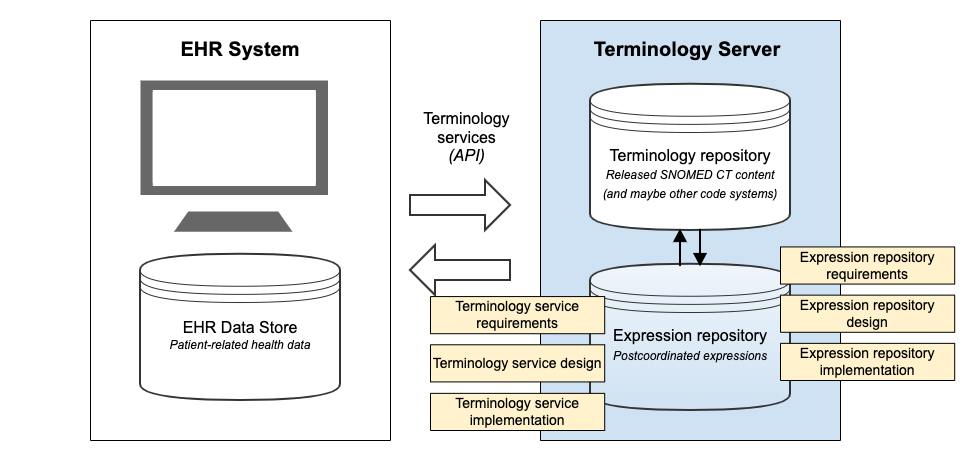
As illustrated in the image below, the terminology server should, therefore, be designed to hold the given versioned SNOMED CT Edition, and an expression repository to hold the postcoordinated expressions. Furthermore, in addition to the services required by the EHR to use the content and derivatives of released SNOMED CT Editions (see [Terminology Services Guide](https://docs.snomed.org/snomed-ct-practical-guides/snomed-ct-terminology-services-guide/)), services are required to support the use of the postcoordinated content.
Overall EHR design with a terminology server supporting postcoordination.
The following pages will elaborate on the requirements, overall design, and implementation of a SNOMED CT-enabled expression repository, and present the services needed for supporting expressions in a terminology server.
Provide Feedback
---
# Agent Instructions
This documentation is published with GitBook. GitBook is the documentation platform designed so that both humans and AI agents can read, navigate, and reason over technical content effectively. Learn more at gitbook.com.
## Querying This Documentation
If you need additional information that is not directly available in this page, you can query the documentation dynamically by asking a question.
Perform an HTTP GET request on the current page URL with the `ask` query parameter, and the optional `goal` query parameter:
```
GET https://docs.snomed.org/snomed-ct-practical-guides/snomed-ct-postcoordination-guide/expressions-in-a-terminology-server.md?ask=&goal=
```
`ask` is the immediate question: it should be specific, self-contained, and written in natural language.
`goal` is optional and describes the broader end goal you are ultimately trying to accomplish on behalf of the user. GitBook uses it to tailor the answer towards what is most useful for that goal.
The response will contain a direct answer to the question and relevant excerpts and sources from the documentation.
Use this mechanism when the answer is not explicitly present in the current page, you need clarification or additional context, or you want to retrieve related documentation sections.