> For the complete documentation index, see [llms.txt](https://docs.snomed.org/llms.txt). Markdown versions of documentation pages are available by appending `.md` to page URLs; this page is available as [Markdown](https://docs.snomed.org/snomed-ct-practical-guides/snomed-ct-postcoordination-guide/expressions-in-a-terminology-server/implementation.md). Agents can also search and read this documentation through its [MCP server](https://docs.snomed.org/~gitbook/mcp).

# Implementation

This guide does not mandate a particular way to meet the requirements and the design of an expression repository as outlined in [Requirements](https://github.com/SNOMED-Documents/snomed-postcoordination-guide/blob/main/expressions-in-a-terminology-server/5.1%20requirements) and [Design](https://github.com/SNOMED-Documents/snomed-postcoordination-guide/blob/main/expressions-in-a-terminology-server/5.2%20design). However, to ensure that terminology servers supporting postcoordination are implemented in a way that doesn't compromise terminological integrity and clinical safety, this section presents considerations important for the implementation of an expression repository. Also, different approaches to implementations are be presented.

## Ensuring Safety

When implementing a terminology server supporting postcoordination with SNOMED CT, careful considerations must be taken to ensure that the approach taken doesn't compromise safety. As a combined effort between the terminology server and the client, the following criteria for expressions must, therefore, be ensured:

* *All* expressions should conform to the concept model when represented in their classifiable form
* *No* ambiguity is allowed, i.e. the transformation of the expression into its classifiable form must not result in a modification of the intended meaning of the expression

Meeting these criteria can be done in several ways and depends on the responsibility taken by the terminology server and client respectively.

## Transformation Levels

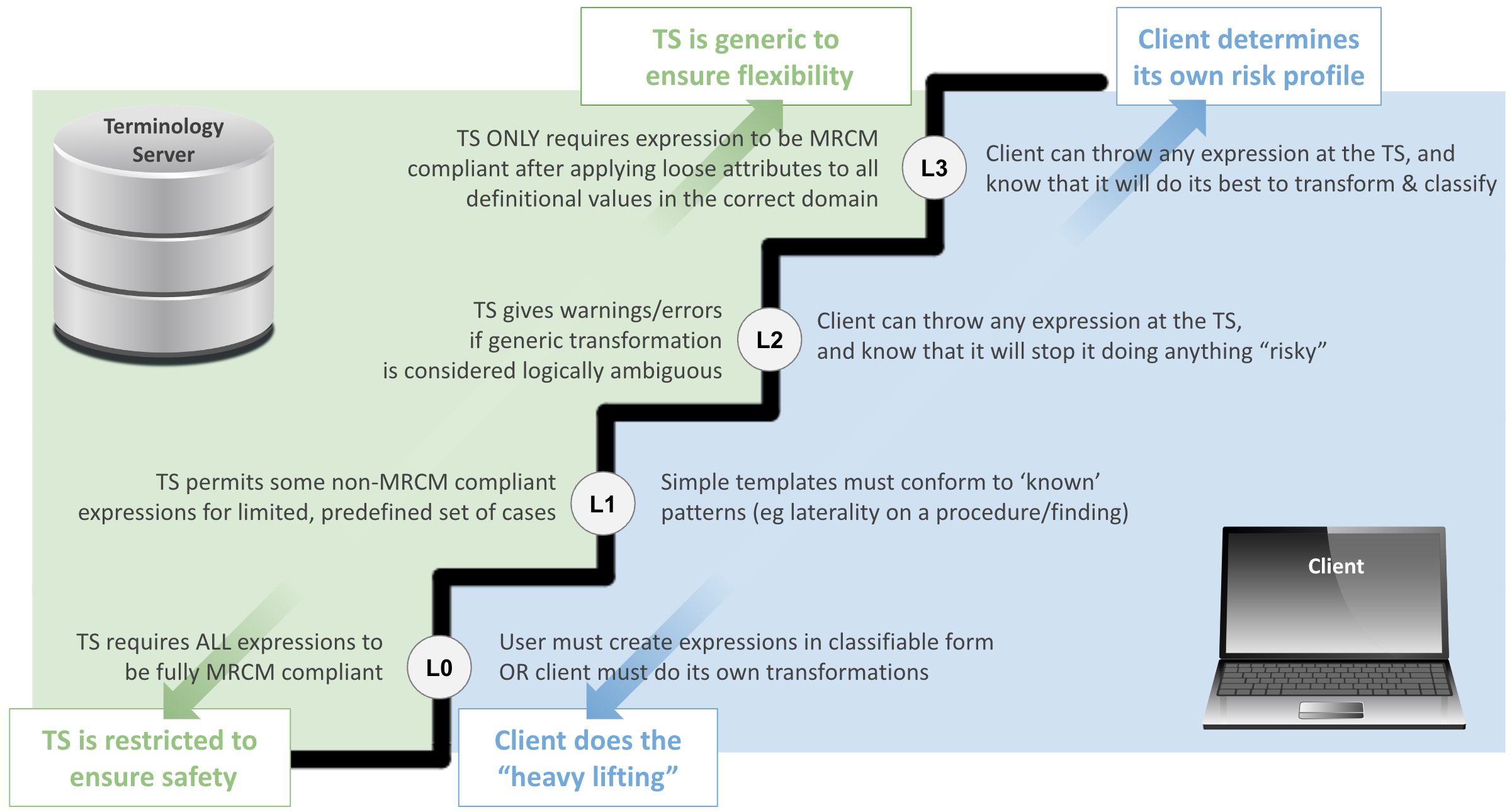
Each terminology server designed to enable postcoordination with SNOMED CT should clearly specify the level of transformation supported, to enable requirements to be specified for the client side, and to support decisions about the use of postcoordination for the specific implementation. The diagram below illustrates four levels of support for postcoordination. At each level, the sum of restrictions provided by the terminology server and the client must ensure that the criteria for 'safe' postcoordinations are met.

<figure><img src="https://2240938627-files.gitbook.io/~/files/v0/b/gitbook-x-prod.appspot.com/o/spaces%2FusjN9isxKh4cLDTFopLg%2Fuploads%2Fgit-blob-27b4625114b9c4a84c3b5abac53e51c13b77d078%2F180917831.png?alt=media" alt=""><figcaption><p>Figure 5.3-1: Overview of the four levels for support of postcoordination.</p></figcaption></figure>

## **Terminology server transformations supported at the different levels**

<table><thead><tr><th width="93.0859375">Level</th><th width="286.62890625">Description</th><th>CTU</th><th width="138.9140625">CF</th></tr></thead><tbody><tr><td><strong>Level 0</strong></td><td>The terminology server will classify the expression without transformation.The client is responsible for ensuring that expressions are fully MRCM-compliant.</td><td>CTU should be fully MRCM compliant</td><td>Same as CTU</td></tr><tr><td><strong>Level 1</strong></td><td>The terminology server behaves as in level 0 if the expression is fully MRCM compliant. The terminology server will apply transformations based on known close-to-user form patterns to generate the classifiable form.The client is responsible for ensuring that expressions are fully MRCM-compliant or conform to allowed close-to-user form patterns.</td><td>CTU should be fully MRCM compliant or conform to close-to-user form patterns</td><td>Generated by transformation</td></tr><tr><td><strong>Level 2</strong></td><td><em>The transformation logic for these levels has not yet been agreed. At this stage, postcoordinations and transformation logic beyond the patterns described at level 1 are, therefore, not recommended.</em></td><td>N/A</td><td></td></tr><tr><td><strong>Level 3</strong></td><td>N/A</td><td>N/A</td><td>N/A</td></tr></tbody></table>

<a href="https://docs.google.com/forms/d/e/1FAIpQLScTmbZIf0UEQwYDkY27EEWBkaiYkHSbR0_9DmFrMLXoQLyL7Q/viewform?usp=pp_url&#x26;entry.1767247133=Postcoordination+Guide&#x26;entry.670899847=Implementation" class="button primary">Provide Feedback</a>


---

# Agent Instructions
This documentation is published with GitBook. GitBook is the documentation platform designed so that both humans and AI agents can read, navigate, and reason over technical content effectively. Learn more at gitbook.com.

## Querying This Documentation
If you need additional information that is not directly available in this page, you can query the documentation by asking a question.

Perform an HTTP GET request on the following URL with the `ask` and `goal` query parameters:

```
GET https://docs.snomed.org/snomed-ct-practical-guides/snomed-ct-postcoordination-guide/expressions-in-a-terminology-server/implementation.md?ask=<question>&goal=<user_goal>
```

`ask` is the immediate question: it should be specific, self-contained, and written in natural language.
`goal` is what the user is ultimately trying to achieve, the reason they need the answer. Sharing it helps GitBook give you a better, more relevant answer. A goal is most helpful when it describes the outcome the user wants rather than restating the question. For example, with `ask=how do I create an API token`, a goal like `automate deployments from our CI pipeline` lets GitBook tailor the answer to that use case.

The response will contain a direct answer to the question and relevant excerpts and sources from the documentation.

Use this mechanism when the answer is not explicitly present in the current page, you need clarification or additional context, or you want to retrieve related documentation sections.
