# Automatic Creation of Display Terms

Automatic Creation of Display Terms

Use Cases

Some situations may require expressions to be displayed differently from how they were created. For example

* **Communication and display of expressions**
  * *When the information structures used to create the expression are different to those available*\
    \&#xNAN;*for display or exchange*
* **Design-time authoring of expressions**
  * *When postcoordinated expressions are created during the design of an EHR implementation*

Communication and Display of Expressions

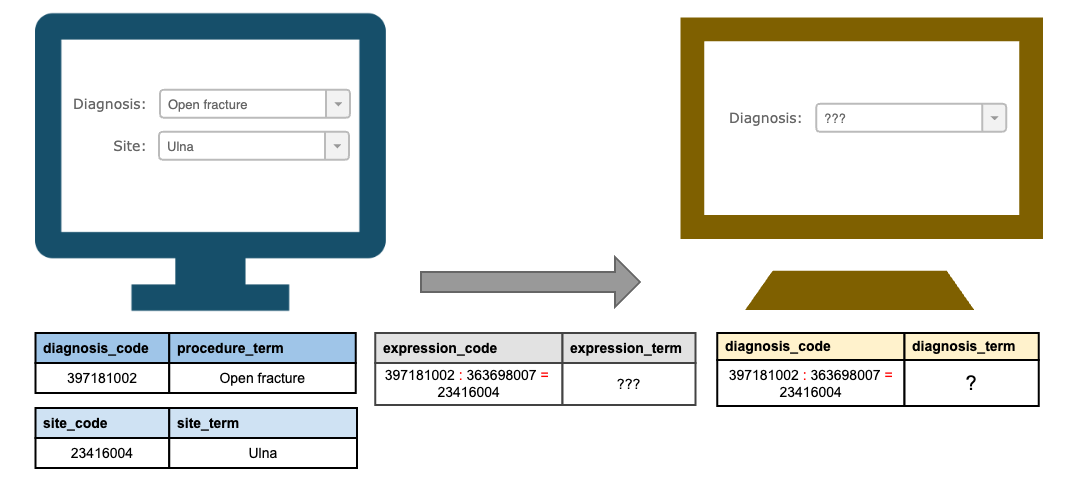
Autogeneration of display terms for postcoordinated expressions may be required when an expression is created in a different clinical system, or a different form on the same system, or it needs to be exchanged using a different information structure. In these cases, the information structure used to create the expression may be different to the ones available to display or exchange the expression and, therefore, the autogeneration of terms may be required.

This situation is illustrated in the image below where the meaning of "open fracture of ulna" is captured in an information structure using two data elements and communicated to a target structure with only a single data element for the same meaning. In some settings, it may be applicable to support the display of the expression in the target system by automatically generating a term.

<figure><img src="https://2240938627-files.gitbook.io/~/files/v0/b/gitbook-x-prod.appspot.com/o/spaces%2FusjN9isxKh4cLDTFopLg%2Fuploads%2Fgit-blob-06e4639927393e878588aeb54ec55a6905ca6b7a%2F180917684.png?alt=media" alt=""><figcaption><p>Some situations require a term to be generated for an expression, e.g. when the expression parts are captured as individual items but communicated to a target system populating the meaning in a single item.</p></figcaption></figure>

Design-time Authoring of Display Terms for Expressions

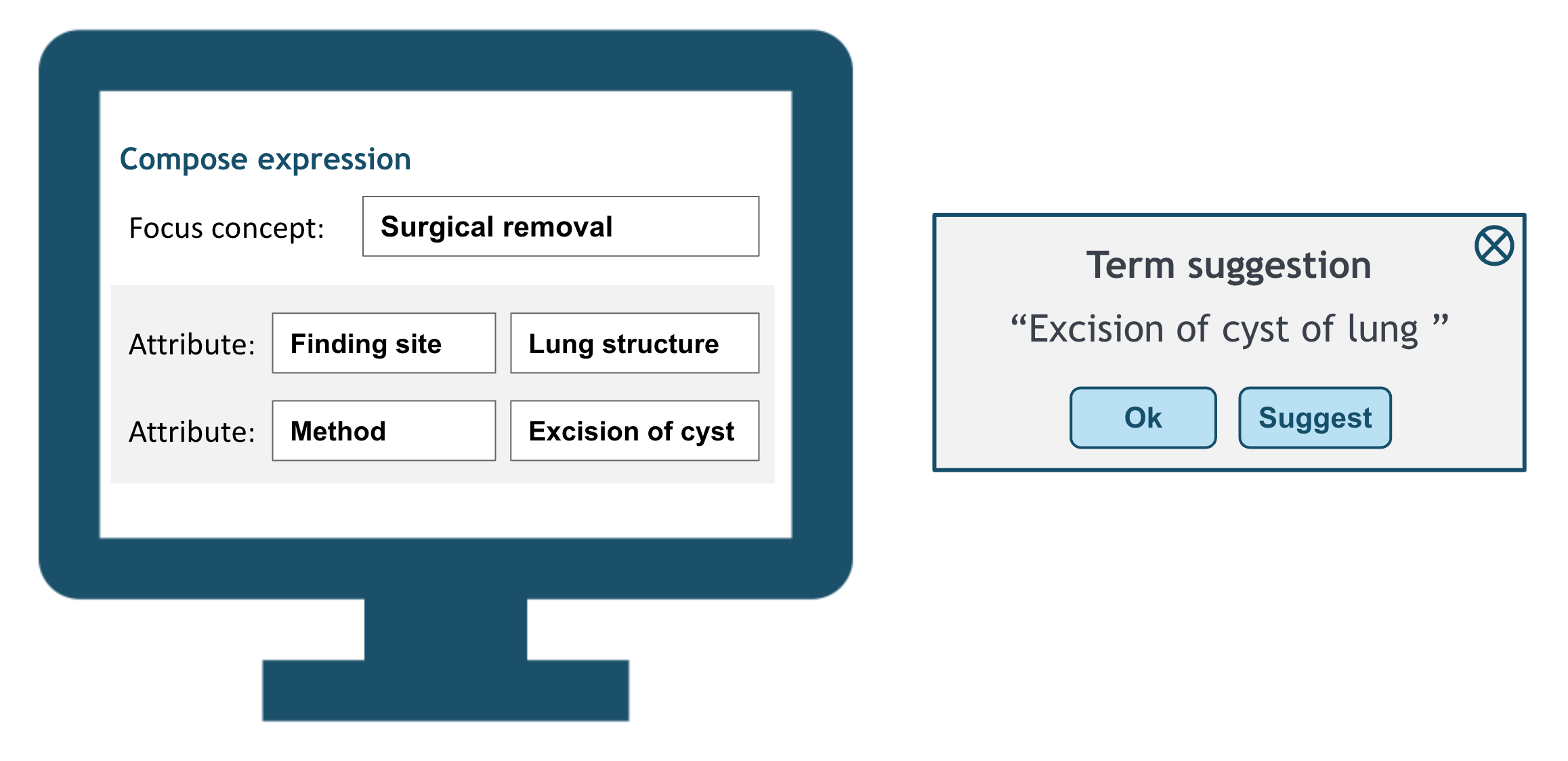
Another situation where autogenerated terms may be useful is in systems used to create postcoordinated expressions during the design of an EHR implementation. At design time, an expression could be created using a form-based expression template, and then the system could suggest a display term that captures the meaning of the whole expression.

This scenario is illustrated in the image below.

<figure><img src="https://2240938627-files.gitbook.io/~/files/v0/b/gitbook-x-prod.appspot.com/o/spaces%2FusjN9isxKh4cLDTFopLg%2Fuploads%2Fgit-blob-525a604f1b4b251093f56c5fa7dcd720a41aebc4%2F180917681.png?alt=media" alt=""><figcaption><p>Systems supporting the creation of postcoordinated expressions may automatically suggest a display term for the expression.</p></figcaption></figure>

**Terminology services**

The techniques to generate a display term for the expressions may differ between implementations, but the following service is required by a terminology server supporting the automatic generation of a display term for an expression:

* Get Display Term
*

<a href="https://docs.google.com/forms/d/e/1FAIpQLScTmbZIf0UEQwYDkY27EEWBkaiYkHSbR0_9DmFrMLXoQLyL7Q/viewform?usp=pp_url&#x26;entry.1767247133=Postcoordination+Guide&#x26;entry.670899847=automatic-creation-of-display-terms" class="button primary">Provide Feedback</a>


---

# Agent Instructions: Querying This Documentation

If you need additional information that is not directly available in this page, you can query the documentation dynamically by asking a question.

Perform an HTTP GET request on the current page URL with the `ask` query parameter:

```
GET https://docs.snomed.org/snomed-ct-practical-guides/snomed-ct-postcoordination-guide/expressions-in-the-ehr/displaying-expressions-in-an-ehr/automatic-creation-of-display-terms.md?ask=<question>
```

The question should be specific, self-contained, and written in natural language.
The response will contain a direct answer to the question and relevant excerpts and sources from the documentation.

Use this mechanism when the answer is not explicitly present in the current page, you need clarification or additional context, or you want to retrieve related documentation sections.