# Store Expression Identifier

In some cases, it may be preferred or required to use a single identifier to represent the stored expression. With this approach, a unique local identifier is assigned to each expression, so that this can be stored in the health record in the place of the full expression. This approach may be selected if the clinical system has a limit on the length of the codes that are recorded in their health records.

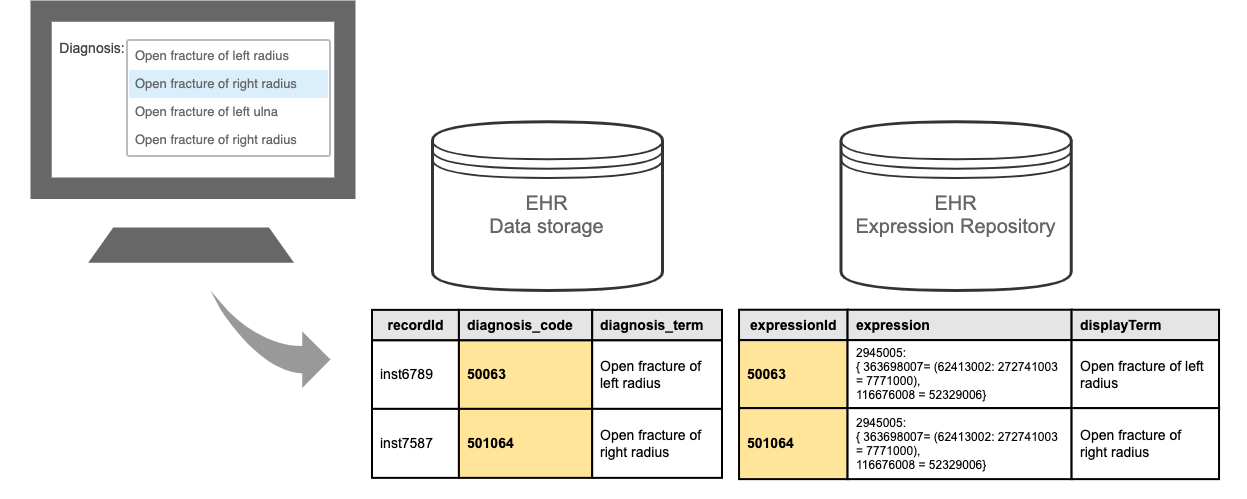
When local expression identifiers are used, these are then linked to the corresponding full expression and display term within an Expression Repository, as illustrated in the image below.

<figure><img src="https://2240938627-files.gitbook.io/~/files/v0/b/gitbook-x-prod.appspot.com/o/spaces%2FusjN9isxKh4cLDTFopLg%2Fuploads%2Fgit-blob-442859b10540c1741194bcce4f96b5e52ceea2a2%2F180917663.png?alt=media" alt=""><figcaption><p>This image illustrates the principles of storing postcoordinated expressions in an expression repository. The EHR data store uses local expression identifiers which are linked to a SNOMED CT expression and display term within the expression repository</p></figcaption></figure>

**Terminology services**

Storing an expression identifier requires the expression to first be added to the expression repository, and assigned a unique identifier. The resulting identifier will be stored in the EHR data store.\
For this purpose, the following services may be required:

* **Lookup Expression**[ ](https://github.com/SNOMED-Documents/snomed-postcoordination-guide/blob/main/expressions-in-the-ehr/storing-patient-data-using-expressions/broken-reference/README.md)- to get the identifier of the expression to be stored.
* **Add Expression**. This is only required in cases where the expression does not already exist in the expression repository.

{% hint style="info" %}
More information about the Terminology Services requirements please see: [terminology-services-requirements](https://docs.snomed.org/snomed-ct-practical-guides/snomed-ct-postcoordination-guide/expressions-in-a-terminology-server/requirements/terminology-services-requirements "mention")
{% endhint %}

<a href="https://docs.google.com/forms/d/e/1FAIpQLScTmbZIf0UEQwYDkY27EEWBkaiYkHSbR0_9DmFrMLXoQLyL7Q/viewform?usp=pp_url&#x26;entry.1767247133=Postcoordination+Guide&#x26;entry.670899847=Store%20Expression%20Identifier" class="button primary">Provide Feedback</a>


---

# Agent Instructions: Querying This Documentation

If you need additional information that is not directly available in this page, you can query the documentation dynamically by asking a question.

Perform an HTTP GET request on the current page URL with the `ask` query parameter:

```
GET https://docs.snomed.org/snomed-ct-practical-guides/snomed-ct-postcoordination-guide/expressions-in-the-ehr/storing-patient-data-using-expressions/store-expression-identifier.md?ask=<question>
```

The question should be specific, self-contained, and written in natural language.
The response will contain a direct answer to the question and relevant excerpts and sources from the documentation.

Use this mechanism when the answer is not explicitly present in the current page, you need clarification or additional context, or you want to retrieve related documentation sections.
