> For the complete documentation index, see [llms.txt](https://docs.snomed.org/llms.txt). Markdown versions of documentation pages are available by appending `.md` to page URLs; this page is available as [Markdown](https://docs.snomed.org/snomed-ct-practical-guides/snomed-ct-postcoordination-guide/expressions-in-the-ehr/storing-patient-data-using-expressions/store-expression-parts-individually.md).

# Store Expression Parts Individually

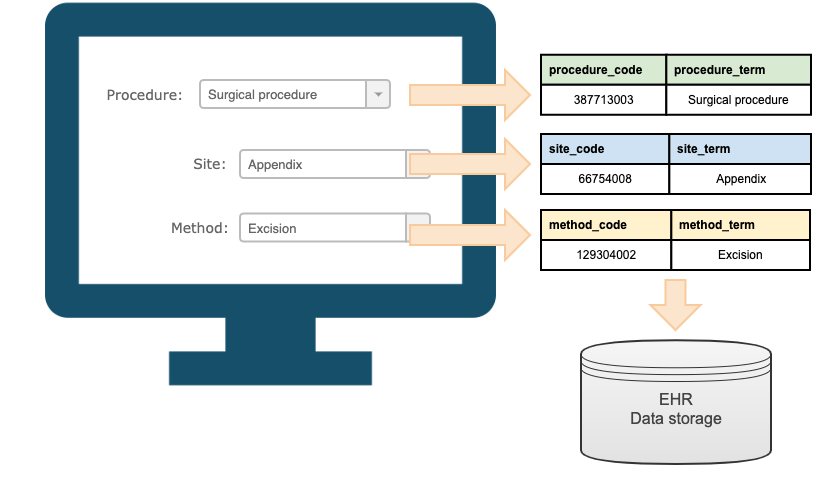
When clinical data is entered in an EHR using a number of interconnected data elements, the composition of the individual data items may derive a postcoordinated expression. This is exemplified in the image below where three data entry controls are used to form the clinical meaning of "an excision of the appendix structure", see the image below.

<figure><img src="https://2240938627-files.gitbook.io/~/files/v0/b/gitbook-x-prod.appspot.com/o/spaces%2FusjN9isxKh4cLDTFopLg%2Fuploads%2Fgit-blob-035003dd6357b2594536411b162489e4e9048aca%2F180917667.png?alt=media" alt=""><figcaption><p>Form-based approach to data entry, where the expression parts are stored in separate fields.</p></figcaption></figure>

With this approach, it is recommended to store the data in an information structure that matches the fields on the form and to record the concept identifier and display term for each of the fields, within that information structure. This enables the system to efficiently display health records that have been recorded previously, and also provides full traceability of what the user selected at the point of data entry.

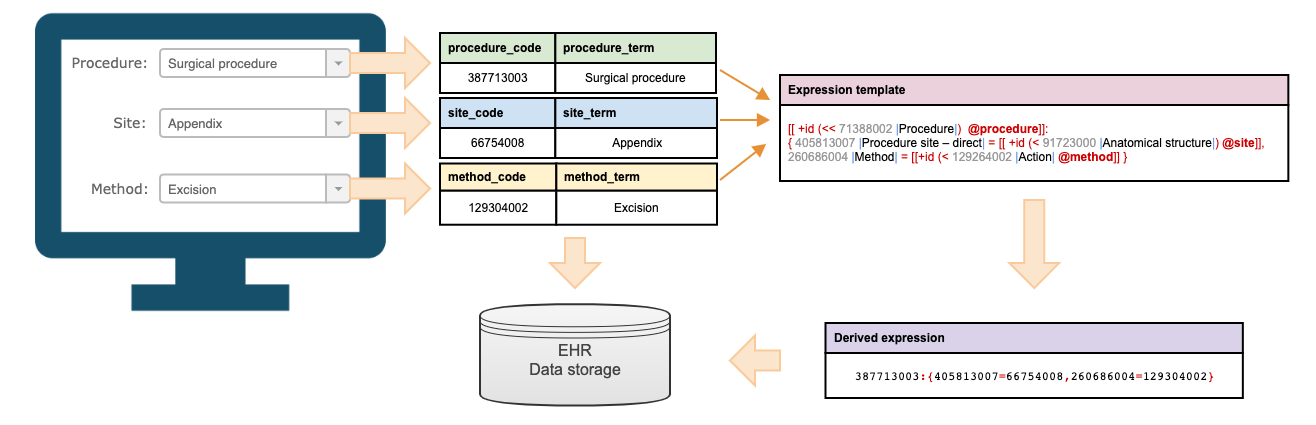
### Store Derived Expression

Aside from storing the individual data items, the associated postcoordinated expression may also be generated using an expression template and stored, if this is needed for other EHR tasks. The principle of this approach is illustrated in the diagram below where the derived expression represents the combined meaning of the selected values. In this example, the concept id for [| surgical procedure|](http://snomed.info/id/387713003) replaces the @procedure slot in the expression template. The concept id of [| Appendix|](http://snomed.info/id/66754008) replaces the @site slot, and the concept id for [| Excision|](http://snomed.info/id/129304002) replaces the @method slot.

The benefit of this approach is that changes to the modelling of a particular branch in SNOMED CT will only require an update to the applied expression, instead of every single expression.

Some implementations may choose to store this derived expression, in addition to the individual values of each field, to support run-time querying or exchange.

<figure><img src="https://2240938627-files.gitbook.io/~/files/v0/b/gitbook-x-prod.appspot.com/o/spaces%2FusjN9isxKh4cLDTFopLg%2Fuploads%2Fgit-blob-e6e53ad55098ac88811d54937caf20df5e175f3e%2F180917669.png?alt=media" alt=""><figcaption><p>Illustration of the principle of using an expression template to generate a postcoordinated expression from the data recorded using the form-based approach to data entry.</p></figcaption></figure>

<a href="https://docs.google.com/forms/d/e/1FAIpQLScTmbZIf0UEQwYDkY27EEWBkaiYkHSbR0_9DmFrMLXoQLyL7Q/viewform?usp=pp_url&#x26;entry.1767247133=Postcoordination+Guide&#x26;entry.670899847=Store%20Expression%20Parts%20Individually" class="button primary">Provide Feedback</a>


---

# Agent Instructions
This documentation is published with GitBook. GitBook is the documentation platform designed so that both humans and AI agents can read, navigate, and reason over technical content effectively. Learn more at gitbook.com.

## Querying This Documentation
If you need additional information that is not directly available in this page, you can query the documentation by asking a question.

Perform an HTTP GET request on the following URL with the `ask` and `goal` query parameters:

```
GET https://docs.snomed.org/snomed-ct-practical-guides/snomed-ct-postcoordination-guide/expressions-in-the-ehr/storing-patient-data-using-expressions/store-expression-parts-individually.md?ask=<question>&goal=<user_goal>
```

`ask` is the immediate question: it should be specific, self-contained, and written in natural language.
`goal` is what the user is ultimately trying to achieve, the reason they need the answer. Sharing it helps GitBook give you a better, more relevant answer. A goal is most helpful when it describes the outcome the user wants rather than restating the question. For example, with `ask=how do I create an API token`, a goal like `automate deployments from our CI pipeline` lets GitBook tailor the answer to that use case.

The response will contain a direct answer to the question and relevant excerpts and sources from the documentation.

Use this mechanism when the answer is not explicitly present in the current page, you need clarification or additional context, or you want to retrieve related documentation sections.