# Knowledge Linkage

Linking SNOMED CT components to knowledge resources (such as clinical guidelines or decision support systems) is a way of adding significant value to electronic health records.

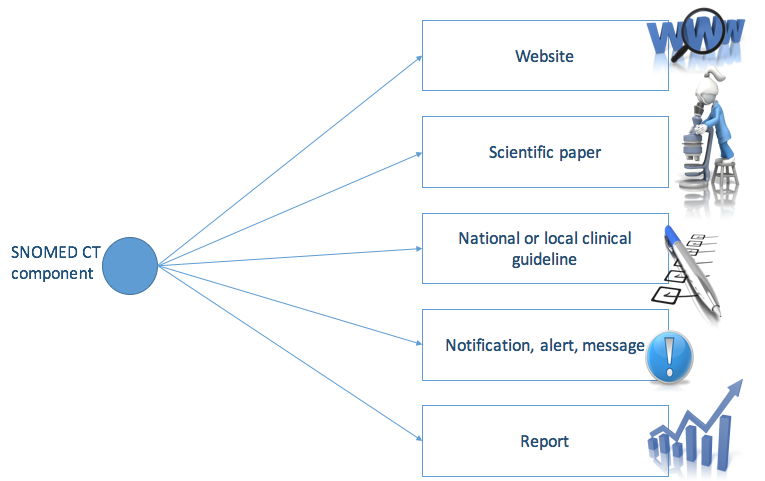
The diagram below illustrates the range of use cases for knowledge linkage including presenting alerts to the user, displaying relevant clinical guidelines and treatment protocols, or automatically populating an order, message or report.

<figure><img src="/files/wBpsjBlENPY4XY693YHE" alt=""><figcaption><p>Components annotated with additional information can support different levels of knowledge linkage</p></figcaption></figure>

Reference sets can be used to enable knowledge linkage in different ways. Examples include but are not limited to:

* **Annotation reference sets** can be used to add a linkage between a referenced component and a string-representation of a specific knowledge resources.
* **Association reference sets** can be used to create associations between SNOMED CT components to enable documentation and/or decision support, using the associations as a simple rule-representation.
* **Simple map reference sets**, **complex and extended map reference sets** can be used to define maps from other code systems to SNOMED CT, and function as a linkage to sources of non SNOMED CT-encoded information

For a more detailed use case, please refer to the following example about linking concepts to web resources:

## Linking Concepts to Web Resources

In the example below URLs are used to annotate two SNOMED CT concepts with images on the web. It is not recommended to use this approach to annotate concepts with text that may require translation to other languages. Instead, such text should be included under an appropriate description type within the Description file. However, in some cases this type of reference set can be useful to link concepts or descriptions to specific guidance documents or other types of knowledge resources.

Table: Example of an associated image annotation reference set

<table><thead><tr><th width="364.16015625">refsetId</th><th width="243.6640625">referencedComponentId</th><th width="410.23828125">Annotation</th></tr></thead><tbody><tr><td>900000000000517004 <mark style="color:blue;">|</mark> Associated image<mark style="color:blue;">|</mark></td><td>80891009 <mark style="color:blue;">|</mark> Heart structure<mark style="color:blue;">|</mark></td><td><a href="http://en.wikipedia.org/wiki/Heart#mediaviewer/-File:Wiki_Heart_Antomy_Ties_van_Brussel.jpg">http://en.wikipedia.org/wiki/Heart#mediaviewer/-File:Wiki_Heart_Antomy_Ties_van_Brussel.jpg</a></td></tr><tr><td>900000000000517004 <mark style="color:blue;">|</mark> Associated image<mark style="color:blue;">|</mark></td><td>86174004 <mark style="color:blue;">|</mark> Laparoscope<mark style="color:blue;">|</mark></td><td><a href="http://www.mdguidelines.com/images/Illustrations/laparosc.jpg">http://www.mdguidelines.com/images/Illustrations/laparosc.jpg</a></td></tr></tbody></table>

<a href="https://docs.google.com/forms/d/e/1FAIpQLScTmbZIf0UEQwYDkY27EEWBkaiYkHSbR0_9DmFrMLXoQLyL7Q/viewform?usp=pp_url&#x26;entry.1767247133=Refset+Guide&#x26;entry.670899847=Knowledge%20Linkage" class="button primary">Provide Feedback</a>


---

# Agent Instructions: Querying This Documentation

If you need additional information that is not directly available in this page, you can query the documentation dynamically by asking a question.

Perform an HTTP GET request on the current page URL with the `ask` query parameter:

```
GET https://docs.snomed.org/snomed-ct-practical-guides/snomed-ct-reference-set-guide/3-requirements-and-use-cases/3.2-use-cases/3.2.2-knowledge-linkage.md?ask=<question>
```

The question should be specific, self-contained, and written in natural language.
The response will contain a direct answer to the question and relevant excerpts and sources from the documentation.

Use this mechanism when the answer is not explicitly present in the current page, you need clarification or additional context, or you want to retrieve related documentation sections.
