> For the complete documentation index, see [llms.txt](https://docs.snomed.org/llms.txt). Markdown versions of documentation pages are available by appending `.md` to page URLs; this page is available as [Markdown](https://docs.snomed.org/snomed-ct-specifications/snomed-ct-diagramming-specification/appendix/appendix-a-template-expressions.md).
# Appendix A - Template Expressions
This appendix describes potential future changes designed to support template expressions. That is, expressions with predefined variables which when assigned values populate the expression.
As these are potential future extensions, this section is not a normative part of this document. It exists to gather feedback on proposed handling of template expressions. Once appropriate extensions are made to the SNOMED CT Compositional Grammar to support template extensions this section will be updated with feedback and moved to the normative part of this document.
## Slots
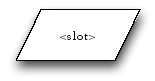
For diagrams representing a template expression or definition, it is possible to represent "slots" which represent a placeholder a concept can fill when the template is used (see A.3). Slots are expressed using a parallelogram as shown below. The name of the slot can be considered like a variable for replacement and is surrounded by angle brackets "<" and ">".
## Color for Slots
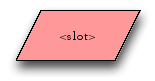
Slots as described in section A.1 are optionally coloured with RGB FF9999 (decimal 255, 153, 153) as shown below:
## Concept Definition Template Diagrams
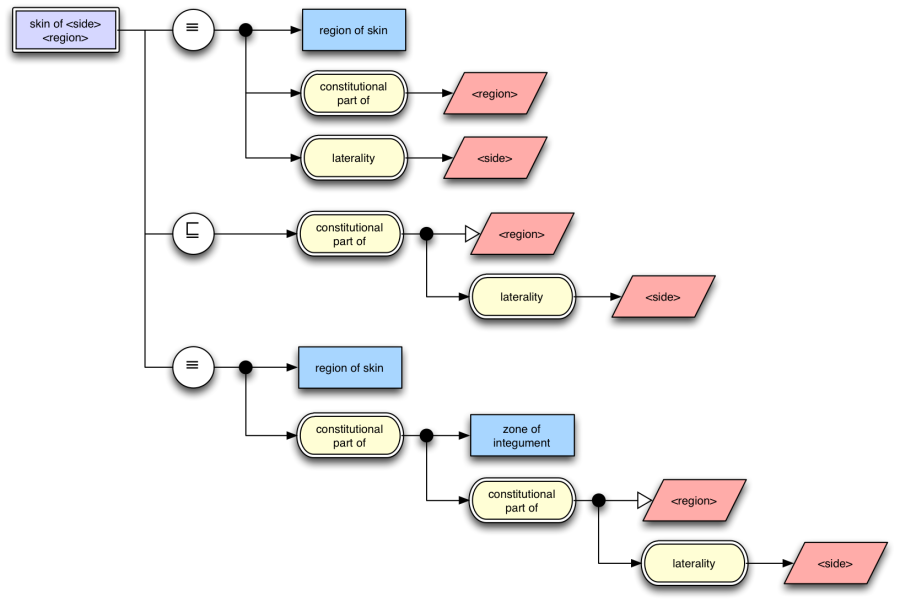
Using the "slot" element described in A.1 it is possible to define diagrams that represent a template for concept definition or expressions. It is then possible to use this template to create concepts or expressions by filling the "slots" with appropriate concepts.
Figure Appendix A-1: Example template diagram using "slots"
These template diagrams are a specialisation of concept definition diagrams as described in section 3.2; however, some of the attribute value concepts are replaced by "slots", making the definition general and reusable.
Note the names provided for the "slots" are enclosed in angle brackets "<" and ">". These slot names are inserted into the name of the concept in the top left of the diagram.
The names associated with slots operate as unique variable names for a diagram or set of diagrams. When populated, every slot with the same name on a diagram, or set of related diagrams, receives the same concept value associated with that slot name. Unless all slots names used are assigned concept values, the expression is not complete.
Provide Feedback
---
# Agent Instructions
This documentation is published with GitBook. GitBook is the documentation platform designed so that both humans and AI agents can read, navigate, and reason over technical content effectively. Learn more at gitbook.com.
## Querying This Documentation
If you need additional information that is not directly available in this page, you can query the documentation by asking a question.
Perform an HTTP GET request on the following URL with the `ask` and `goal` query parameters:
```
GET https://docs.snomed.org/snomed-ct-specifications/snomed-ct-diagramming-specification/appendix/appendix-a-template-expressions.md?ask=&goal=
```
`ask` is the immediate question: it should be specific, self-contained, and written in natural language.
`goal` is what the user is ultimately trying to achieve, the reason they need the answer. Sharing it helps GitBook give you a better, more relevant answer. A goal is most helpful when it describes the outcome the user wants rather than restating the question. For example, with `ask=how do I create an API token`, a goal like `automate deployments from our CI pipeline` lets GitBook tailor the answer to that use case.
The response will contain a direct answer to the question and relevant excerpts and sources from the documentation.
Use this mechanism when the answer is not explicitly present in the current page, you need clarification or additional context, or you want to retrieve related documentation sections.