> For the complete documentation index, see [llms.txt](https://docs.snomed.org/llms.txt). Markdown versions of documentation pages are available by appending `.md` to page URLs; this page is available as [Markdown](https://docs.snomed.org/snomed-ct-specifications/snomed-ct-editorial-guide/readme/concept-model-overview/root-and-top-level-concepts.md).
# Root and Top-level Concepts
## Concept
A *concept* is defined as a clinical idea to which a unique concept identifier has been assigned. Concepts are associated with descriptions that contain human-readable terms describing the concept.
A *term* is defined as a human-readable phrase that names or describes a concept. A term is one of the properties of a description. Other properties of a description link the term to an identified concept and indicate the type of description, e.g. Fully Specified Name, Preferred Term, Synonym.
Concepts are linked to their more general parent concepts directly above them in a hierarchy. More general meanings, are usually at the top of the hierarchy. Descending levels of the hierarchy contain more specific or specialized meanings.
Concepts are logically defined by their relationships to each other.
In SNOMED CT, the default meaning of a concept is defined above. However, a concept may have other meanings in SNOMED CT, such as an:
* Abbreviated name for the concept identifier. For clarity, this is should be referred to as an *identifier*(*ID*), *code,* or *concept identifier* (*ID*).
* Idea or class of real-world entities (common usage meaning). For clarity, this is should be referred to as a *clinical idea* , *clinical meaning,* or *code meaning*.
## Root Concept
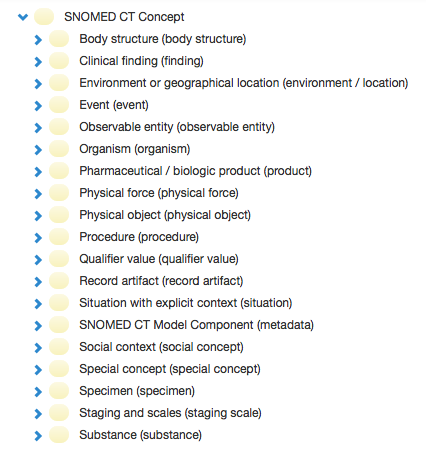
The concept file includes a special concept referred to as the *root concep* t. It is the single concept that is at the top of the SNOMED CT concept hierarchy. All other concepts are descended from this root concept via at least one series of relationships of the Relationship type 116680003 | Is a (attribute)| , i.e. all other concepts are regarded as subclasses of this concept. The root concept code is [138875005 | SNOMED CT Concept (SNOMED RT+CTV3)|](http://snomed.info/id/138875005) . All other SNOMED CT concepts are subtypes of the root concept. Unlike other SNOMED CT concepts, the root concept is not a subtype of any other concept.
## Top-level Concepts
Concepts that are directly related to the root concept by a single relationship of the Relationship type 116680003 | Is a (attribute)| are referred to as *top-level concepts*. All other concepts are descended from at least one top-level concept via at least one series of relationships of the Relationship type 116680003 | Is a (attribute)| , i.e. all other concepts represent subclasses of the meaning of at least one top-level concept.
### Top-level metadata concepts
A concept that is directly related to the root metadata concept, 900000000000441003 | SNOMED CT Model Component (metadata)| by a single relationship of the relationship type IS\_A. All metadata concepts are descended from at least one top-level metadata concept via at least one series of relationships with Relationship type IS\_A. Metadata codes represent structural information about the terminology itself. The top-level metadata concepts represent broad groups of metadata.
## Subtype relationships
Subtype relationships provide the main semantic hierarchy that relates concepts to one another. All active concepts, except the root concept, have subtype relationships with one or more concept. Each of these relationships indicate that a concept is a subtype of another concept.
Subtype relationships are expressed in the same way as other SNOMED CT relationships. They are identifiable by their fully specified names, e.g 116680003 |Is a (attribute)|.
For example,
* 53084003 |Bacterial pneumonia (disorder)| is a subtype of 233604007 |Pneumonia (disorder)| because it is a subtype of 312342009 |Infective pneumonia (disorder)| which is also a subtype of 233604007 |Pneumonia (disorder)|
Provide Feedback
---
# Agent Instructions
This documentation is published with GitBook. GitBook is the documentation platform designed so that both humans and AI agents can read, navigate, and reason over technical content effectively. Learn more at gitbook.com.
## Querying This Documentation
If you need additional information that is not directly available in this page, you can query the documentation by asking a question.
Perform an HTTP GET request on the following URL with the `ask` and `goal` query parameters:
```
GET https://docs.snomed.org/snomed-ct-specifications/snomed-ct-editorial-guide/readme/concept-model-overview/root-and-top-level-concepts.md?ask=&goal=
```
`ask` is the immediate question: it should be specific, self-contained, and written in natural language.
`goal` is what the user is ultimately trying to achieve, the reason they need the answer. Sharing it helps GitBook give you a better, more relevant answer. A goal is most helpful when it describes the outcome the user wants rather than restating the question. For example, with `ask=how do I create an API token`, a goal like `automate deployments from our CI pipeline` lets GitBook tailor the answer to that use case.
The response will contain a direct answer to the question and relevant excerpts and sources from the documentation.
Use this mechanism when the answer is not explicitly present in the current page, you need clarification or additional context, or you want to retrieve related documentation sections.