# Concept Definitions Represented in OWL

This section outlines the rationale for distributing an OWL representation of the stated view of concept definitions and provides an overview of the way OWL axioms are represented in SNOMED CT release files. More detailed information is published separately in the [SNOMED CT OWL Guide](https://app.gitbook.com/o/h8Z6qGxuQrzM9vbx5bPT/s/UVgNFMSypqSsi48DpFEe/) and the [SNOMED CT Logic Profile Specification](https://app.gitbook.com/o/h8Z6qGxuQrzM9vbx5bPT/s/hRUJsLa2ant5L63pkp1O/).

## Rationale for Using OWL

The mismatch between the requirements for representing enhanced concept definitions and the capabilities of the current stated relationship file might in theory be addressed by addition of columns to the file or adding additional information in reference sets. However, in practice this would create a more complex solution able to support a specific set of enhanced features.

Adopting the well-established OWL standards formats offers a more flexible solution that can represent the full range of description logic features. This approach enables SNOMED Internation to specify a particular logic profile to be applied to current releases of SNOMED CT, with the option to extend that profile in the future. Future revisions of the logic profile would not require a change in the distribution file structure provided these were supported by an OWL syntax.

## OWL Axioms

OWL axioms can be represented using several different syntaxes. SNOMED International has chose the OWL Functional Syntax as its standard representation.

The OWL Functional Syntax is a formal representation of the web ontology language (*OWL*) as a simple text base syntax that is used as a bridge between the structural specification and various concrete syntaxes.

#### Related Links

* [OWL Functional-Style Syntax Specification](https://www.w3.org/TR/owl2-syntax/#Functional-Style_Syntax)

## OWL Expression Axiom Set

OWL axioms are distributed in a reference set that follows the [OWL Expression Reference Set](https://docs.snomed.org/snomed-ct-specifications/snomed-ct-release-file-specification/reference-set-release-file-specification/5.2-reference-set-types/5.2.1-content-reference-sets/5.2.1.9-owl-expression-reference-set) specification. The axiom itself is contained in a string field and the concept whose definition it contributes to is referenced by the the referencedComponentId. Although a single row in the reference set can provide a sufficient definition, the definition of a single concept can also include several axioms each represented by a row in the reference set.

## Comparing Stated Relationships and OWL Axioms

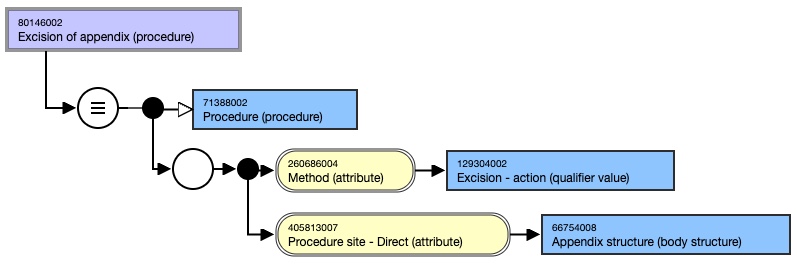
> Figure 2.3.4.2-1 shows the diagrammatic representation of the stated view of the definition of [80146002 |Excision of appendix|](http://snomed.info/id/80146002). Table 2.3.4.2-1 shows the same definition as represented by three rows in the stated relationship file together with the definitionStatusId in the concept file.

<figure><img src="https://1769943195-files.gitbook.io/~/files/v0/b/gitbook-x-prod.appspot.com/o/spaces%2FirKbJsZG57nSWZA4GT0M%2Fuploads%2FUlXrvOjA7x3gyt5oxRcF%2FImage%2015-07-2025%20at%2012.12.jpeg?alt=media&#x26;token=c2647749-9bfd-4b04-97d5-c1e3ad133833" alt=""><figcaption></figcaption></figure>

***

**Stated relationships and definition status for the sufficiently defined concept** [**80146002 |Excision of appendix|**](http://snomed.info/id/80146002)

<table data-header-hidden data-full-width="true"><thead><tr><th></th><th></th><th align="center"></th><th></th><th></th><th></th><th align="center"></th><th></th><th></th><th></th></tr></thead><tbody><tr><td><strong>id</strong></td><td><strong>effective Time</strong></td><td align="center"><strong>active</strong></td><td><strong>..</strong></td><td><strong>sourceId</strong></td><td><strong>destinationId</strong></td><td align="center"><strong>relationship Group</strong></td><td><strong>typeId</strong></td><td><strong>..</strong></td><td><strong>..</strong></td></tr><tr><td>..</td><td>20180731</td><td align="center">1</td><td>..</td><td><p>80146002</p><p><mark style="color:blue;">|</mark>Excision of appendix<mark style="color:blue;">|</mark></p></td><td>71388002 <mark style="color:blue;">|</mark>Procedure<mark style="color:blue;">|</mark></td><td align="center">0</td><td><p>116680003</p><p><mark style="color:blue;">|</mark>Is a<mark style="color:blue;">|</mark></p></td><td>..</td><td>..</td></tr><tr><td>..</td><td>20080731</td><td align="center">1</td><td>..</td><td><p>80146002</p><p><mark style="color:blue;">|</mark>Excision of appendix<mark style="color:blue;">|</mark></p></td><td>129304002 <mark style="color:blue;">|</mark>Excision - action<mark style="color:blue;">|</mark></td><td align="center">1</td><td>260686004 <mark style="color:blue;">|</mark>Method<mark style="color:blue;">|</mark></td><td>..</td><td>..</td></tr><tr><td>..</td><td>20080731</td><td align="center">1</td><td>..</td><td><p>80146002</p><p><mark style="color:blue;">|</mark>Excision of appendix<mark style="color:blue;">|</mark></p></td><td>66754008 <mark style="color:blue;">|</mark>Appendix structure<mark style="color:blue;">|</mark></td><td align="center">1</td><td>405813007 <mark style="color:blue;">|</mark>Procedure site - Direct<mark style="color:blue;">|</mark></td><td>..</td><td>..</td></tr></tbody></table>

***

***

**Example of OWL axiom refset representation of the definition of&#x20;**<mark style="color:blue;">**|**</mark>**Excision of appendix**<mark style="color:blue;">**|**</mark>**.**

<table data-header-hidden data-full-width="true"><thead><tr><th width="87.11245727539062">id</th><th width="98.72503662109375">effectiveTime</th><th width="68.39373779296875" align="center">active</th><th width="87.8375244140625">moduleId</th><th width="111.015625">refsetId</th><th width="110.76251220703125">referenceComponentId</th><th width="380.52496337890625">owlExpression</th></tr></thead><tbody><tr><td><strong>id</strong></td><td><strong>effectiveTime</strong></td><td align="center"><strong>active</strong></td><td><strong>moduleId</strong></td><td><strong>refsetId</strong></td><td><strong>referencedComponentId</strong></td><td><strong>owlExpression</strong></td></tr><tr><td>..</td><td>..</td><td align="center">1</td><td>..</td><td>733073007 <mark style="color:blue;">|</mark>OWL axiom reference set<mark style="color:blue;">|</mark></td><td><p>80146002</p><p><mark style="color:blue;">|</mark>Excision of appendix<mark style="color:blue;">|</mark></p></td><td><p>EquivalentClasses(:80146002 ObjectIntersectionOf(:71388002 ObjectSomeValuesFrom(:609096000 ObjectIntersectionOf(ObjectSomeValuesFrom</p><p>(:260686004 :129304002)ObjectSomeValuesFrom</p><p>(:405813007 :66754008)))))</p></td></tr></tbody></table>

***

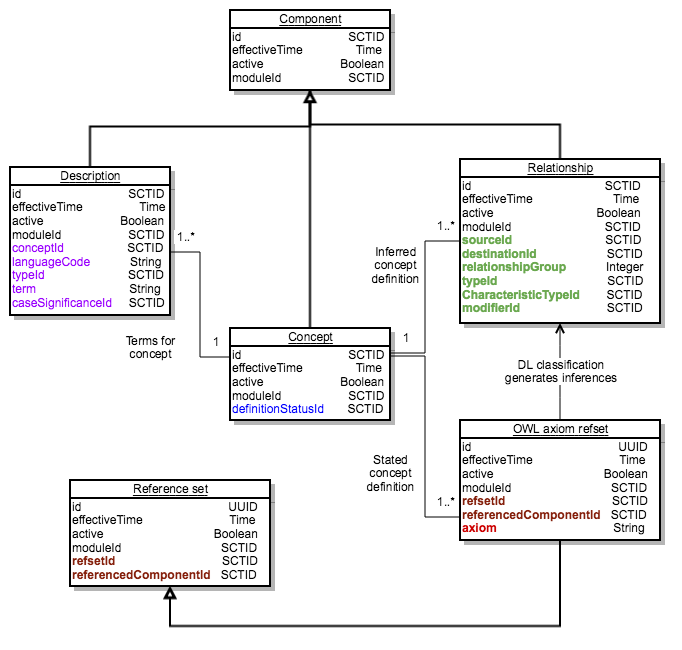
The above table shows a row in the OWL axiom reference set file representing the same definition. As shown by this example, a single sufficient definition is represented by a single row in the reference set. However, some concept definitions may require multiple rows in the reference set. Situations in which multiple row are required include:

* Concepts with multiple sufficient definitions, each of which requires a separate row in the reference set.
* Concepts with additional necessary conditions that are not part of a sufficient definition, each of which requires a separate row in the reference set.

<div data-full-width="true"><figure><img src="https://1769943195-files.gitbook.io/~/files/v0/b/gitbook-x-prod.appspot.com/o/spaces%2FirKbJsZG57nSWZA4GT0M%2Fuploads%2Fgit-blob-49008ad1a0a6a5c69fb82be21d007eceffe63d1c%2F71172651.png?alt=media" alt=""><figcaption></figcaption></figure></div>

***

<a href="https://docs.google.com/forms/d/e/1FAIpQLScTmbZIf0UEQwYDkY27EEWBkaiYkHSbR0_9DmFrMLXoQLyL7Q/viewform?usp=pp_url&#x26;entry.1767247133=Release+File+Specification&#x26;entry.670899847=Concept%20Definitions%20Represented%20in%20OWL" class="button primary">Provide Feedback</a>


---

# Agent Instructions: Querying This Documentation

If you need additional information that is not directly available in this page, you can query the documentation dynamically by asking a question.

Perform an HTTP GET request on the current page URL with the `ask` query parameter:

```
GET https://docs.snomed.org/snomed-ct-specifications/snomed-ct-release-file-specification/logical-model/2.3-concept-definitions/2.3.4-representing-concept-definitions/2.3.4.2-concept-definitions-represented-in-owl.md?ask=<question>
```

The question should be specific, self-contained, and written in natural language.
The response will contain a direct answer to the question and relevant excerpts and sources from the documentation.

Use this mechanism when the answer is not explicitly present in the current page, you need clarification or additional context, or you want to retrieve related documentation sections.